IEA Report: COVID-19, coal and CO2 emissions
S. Himmelstein | March 10, 2022The decline in global carbon emissions evident in the first year of the COVID-19 pandemic was short-lived, as energy-related carbon dioxide emissions rose worldwide by 6% in 2021 to 36.3 billion tons, their highest ever level. Data collected and analyzed by the International Energy Agency (IEA) confirm that the increase in global CO2 emissions of over 2 billion tons was the largest in history in absolute terms, more than offsetting the previous year’s pandemic-induced decline.
Coal accounted for over 40% of the overall growth in global CO2 emissions in 2021, reaching an all-time high of 15.3 billion tons as emissions from natural gas rebounded well above their 2019 levels to 7.5 billion tons. At 10.7 billion tons, CO2 emissions from oil remained significantly below pre-pandemic levels because of the limited recovery in global transport activity in 2021, primarily in the aviation sector.
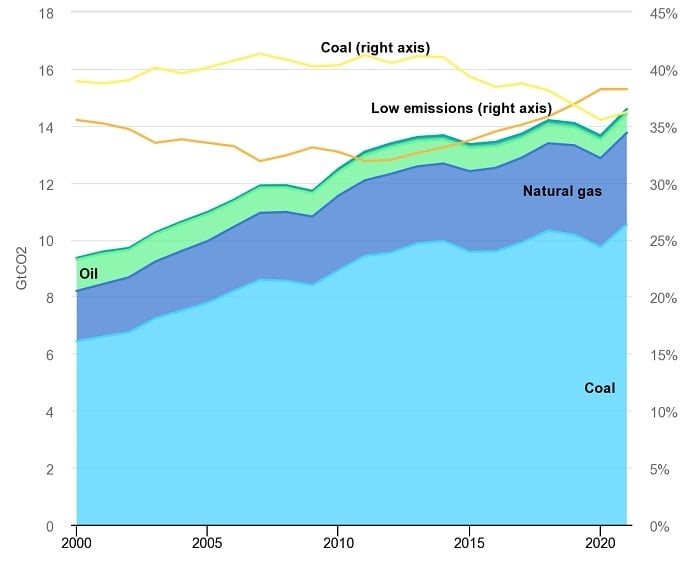 CO2 emissions from electricity and heat production by fuel, and share by fuel, 2000-2021. Source: IEA
The costs of operating existing coal power plants in the U.S. and many European power systems were considerably lower than those of gas power plants for the majority of 2021. Gas-to-coal switching pushed up global CO2 emissions from electricity generation by well over 100 million tons, notably in the U.S. and Europe where competition between gas and coal power plants is tightest.
In China, the only major economy to experience economic growth in both 2020 and 2021, emissions increased by 750 million tons between 2019 and 2021. In 2021, CO2 emissions in China rose above 11.9 billion tons, accounting for 33% of the global total. These increases more than offset the aggregate decline in the rest of the world over the same period.