Economic Growth Continues with Flat Carbon Emissions
Engineering360 News Desk | March 18, 2016Preliminary data for 2015 released by the International Energy Agency (IEA) show that global energy-related carbon dioxide emissions (CO2) of 32.1 billion tons – the largest source of man-made greenhouse gas emissions – stayed flat for the second year in a row.
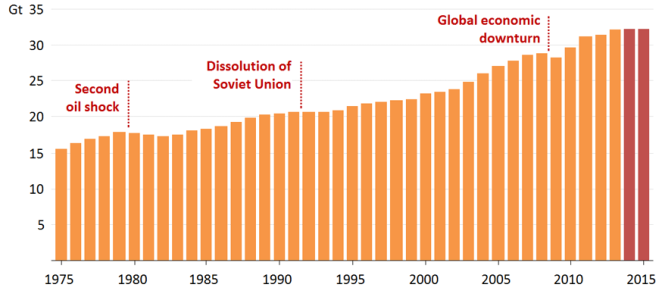 Global energy-related CO2 emissions. Image source: IEAThe data suggest that electricity generated by renewables played a critical role, having accounted for around 90% of new electricity generation in 2015; wind made up more than half of new electricity generation. In parallel, the global economy grew by more than 3 percent, suggesting that the link between economic growth and emissions growth may be weakening.
In the more than 40 years in which the IEA has provided information on CO2 emissions, there have been four other periods in which emissions stood still or fell compared to the previous year. Three of those – the early 1980s, 1992 and 2009 – were associated with global economic weakness. But the recent stall in emissions comes amid economic expansion: according to the International Monetary Fund, global GDP grew by 3.4 percent in 2014 and 3.1 percent in 2015.
China and the U.S., the two largest emitters, both registered a decline in energy-related CO2 in 2015. In China, emissions declined by 1.5 percent as coal use dropped for the second year in a row. The economic restructuring toward less energy-intensive industries and the government’s efforts to decarbonize electricity generation pushed coal use down. In 2015, coal generated less than 70 percent of Chinese electricity, 10 percentage points less than four years ago (in 2011). Over the same period low-carbon sources jumped from 19 percent to 28 percent , with hydro and wind accounting for most of the increase. In the U.S., emissions fell by 2 percent , as a switch from coal to natural gas use in electricity generation took place.
The emissions decline from these two major emitters was offset by rising emissions in most other Asian developing economies and in the Middle East, and also a moderate increase in Europe.