
Efficient energy storage based on electrolytic carbon
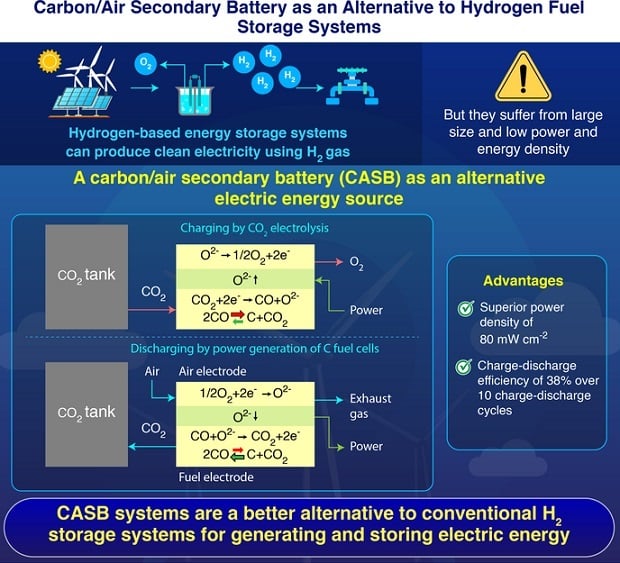
S. Himmelstein | January 10, 2022An alternative to the complex, low efficiency hydrogen storage systems under development to use electrolytic hydrogen for clean power production has been proposed by Tokyo Institute of Technology researchers. A carbon/air secondary battery (CASB) is being advanced as an electric energy storage system that consumes C instead of hydrogen.
C generated via electrolysis of carbon dioxide in the solid-oxide fuel and electrolysis cell is oxidized with air to produce energy. The system can be supplied with compressed liquefied CO2 to make up the energy storage system. According to its developers, the CASB is charged using energy generated by renewable sources to reduce CO2 to C. During the subsequent discharge phase, C is oxidized to generate energy. The energy density of the CASB is limited by the amount of C it can hold in a confined space, but the system offers a higher volumetric energy density compared to hydrogen storage systems.
 Source: Tokyo Institute of Technology
During charge-discharge tests, the transformations between C and CO2 were observed to be due to Boudouard reactions characterized by a redox reaction of a mixture of carbon monoxide (CO), CO2 and C. C was deposited on the electrode via the electrochemical reduction of CO2 and the reduction of CO via the Boudouard decomposition during the charging phase. C was then oxidized to CO and CO2 during discharge via the Boudouard gasification reaction and electrochemical oxidation respectively.
The CASB system exploited most of the C deposited on the electrode for energy generation, demonstrating a high Coulombic efficiency of 84% and indicating that most of the stored energy can be obtained during the discharge phase. Results reported in the Journal of Power Sources confirm a power density of 80 mW/cm2 and a charge-discharge efficiency of 38% that was sustained over 10 charge-discharge cycles, indicating no degradation of the fuel electrode.



