Tech Platform Aims to Help Manage Germany's Energy Transition
Engineering360 News Desk | November 25, 2015German utility RWE and Siemens will collaborate to build a technology platform to connect the country's growing numbers of distributed energy resources.
According to the companies, the RWE Smartpool project will be an advanced IT system designed to create a "cost-effective, mass-market solution for integrating producers, consumers and storage units." It will also expand the ways in which distribution grid operators can integrate distributed power generating facilities—particularly renewable energy sources such as wind and solar—to optimize grid stability.
Renewables' share of Germany's electricity production over the past 15 years has risen from 5% to more than 26% in 2014—more than half of which was generated by wind (9.1%) and solar (5.7%). Under the country's Energiewende policy, renewable sources are targeted to generate 80% of the country's electricity by 2050. But the move away from baseload power—Germany plans to shutter its remaining nuclear plants by 2022—and toward distributed generation necessitates greater coordination among market participants and network operators.
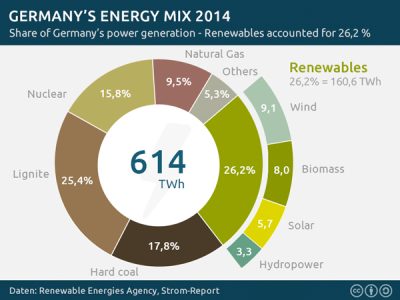 Germany's Energy Mix, 2014. Image credit: Renewable Energies Agency, Strom Report."Many innovative steps must be taken in order to successfully manage the [transition] to the new energy mix," says Dr. Joachim Schneider, CTO of RWE Deutschland AG. "By collaborating with Siemens, we will be able to significantly expand the benefits of new IT technology systems and provide customers and grid operators with efficient solutions for their business."
Essentially, public works and grid operators will be able to use RWE Smartpool to optimize the marketing of what are frequently small amounts of locally generated electricity.
Siemens will license its DEMS decentralized energy management system for the project. The system is based on EnergyIP, Siemens' scalable platform for smart-grid applications.