Technology Could Make Aircraft and Ships Stealthier
Engineering360 News Desk | November 19, 2015Chinese researchers have developed an ultra-thin, tunable microwave absorber that can operate over a broad range of frequencies, potentially improving aircraft and warship cloaking.
The technological advancement is in response to the improvement of radar detection devices, which increasingly can identify segments of the electromagnetic spectrum in the near-meter microwave length.
Conventional radar absorbers are usually too thick and heavy or have too narrow an absorption bandwidth to cloak objects in the equivalent ultra-high-frequency regime (300 megahertz to two gigahertz). To solve this problem, researchers from Huazhong University of Science and Technology in China set about developing an ultra-thin, tunable broadband microwave absorber for ultra-high-frequency applications.
To create an absorber with the desired qualities, the team—led by Jianjun Jiang, a professor at the university's School of Optical and Electronic Information—employed a type of thin, light periodic structure called a frequency-selective surface. The surface comprises an assembly of patterned conductors arranged in a two-dimensional array and backed by a thin dielectric to reflect incident microwaves according to their frequency.
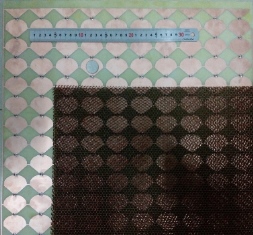 Stretching transformation is applied to the unit cell pattern to expand the tunable bandwidth. Image credit: Intelligent Electronics Institute, Huazhong University.In their experiments, Jiang’s team fabricated a broadband active frequency-selective surface with a stretching transformation pattern on a printed circuit board. They then soldered resistors and varactors between each of the two unit patterned cells. The fact that the surface could be stretched meant that the parameters of the unit patterned cell could be actively controlled by stretching.
By modeling the absorber using a transmission line, the researchers found that the varactor provides a variable capacitance at varying bias voltage, which produces the device’s tenability. Meanwhile, the lumped resistor with constant resistance reliably produces strong absorption at the resonance frequency. Besides the lumped impedances of the loaded elements, the researchers discovered that the parameters of the unit patterned cells contribute to the device’s absorption performance.
The resulting absorption range covers a broad band, from 0.7 to 1.9 gigahertz below -10 decibel, and the total thickness of the absorber is 7.8 millimeters, according to Wenhua Xu, the team's primary researcher.
“Usually the thickness of conventional radar absorbers is a quarter the wavelength of the incident microwave. In the high-frequency regime—take one gigahertz as an example—the thickness of the absorber would be around 7.5 centimeters, which is too thick and heavy to be used in aircraft or warships. Our [absorber] is almost 10 times thinner than conventional ones,” Xu says.