
Windows as transparent solar-thermoelectric systems
S. Himmelstein | August 13, 2021The current crop of window materials incorporating photovoltaic cells perform efficiently in terms of power production but often at the expense of limited window transparency. In pursuit of the best of both worlds, an international research team designed a window with a wavelength-selective film, consisting of cesium tungsten oxide and resin.
This material is characterized by high visible-light transmittance of up to 88% and also allows for efficient and selective harvesting of ultraviolet and infrared light for conversion to heat energy. Thermoelectric devices arranged along the film edges then convert that heat into electricity. A prototype system was demonstrated 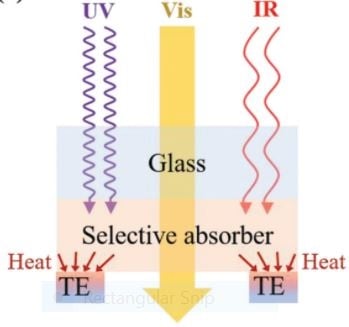 Working principle of transparent power generation windows based on wavelength-selective solar-thermoelectric conversion. Source: Lidong Chen et al.to produce an output voltage of 4 V within an area of 0.01 m2 exposed to sunshine.
The design of the power generating system detailed in Advanced Energy Materials decouples energy conversion efficiency from light transparency of the window, enabling independent regulation for both. This technology can also reduce the cooling load of buildings as a result of infrared light absorption.
Researchers from the Chinese Academy of Sciences, Donghua University (China), Leibniz Institute for Solid State and Materials Research (Germany) and Coventry University (U.K.) contributed to this development.



"A prototype system was demonstrated to produce an output voltage of 4 V within an area of 0.01 m2 exposed to sunshine."
4 volts open circuit but how much power?
0.4 mW / cm2 max (figure 4b below, 40mW for 10cm x 10cm)
Transparent Power‐Generating Windows Based on Solar‐Thermal‐Electr
In reply to #1
Ah but like all Windows systems will it crash when you need it most?
Windows will always be poor solar panels. Transmitting light and absorbing light to convert to electricity are conflicting requirements. In this case, converting light (UV and IR) to heat and then back to electricity adds the loss factor of Carnot efficiency as well as the losses inherent in thermoelectric conversion, electrical resistance and thermal conductance.