Bioengineers Streamline Process for Making Medical App Sensors
Engineering360 News Desk | November 10, 2015Bioengineers at the University of California, San Diego (UCSD), have developed a method that reduces half the time needed to make high-tech flexible sensors for medical applications. The advance brings the sensors one step closer to mass-market manufacturing.
The original fabrication process for the sensors—which are used to monitor vital signs and brain activity in premature babies, pregnant women and patients in intensive care units—involved 10 steps, five of which had to take place in a clean room. The steps to remove the sensors from the silicon wafer thatare built on alone took up to 20 minutes, and theyremained fragile and susceptible to rips and tears.
Todd Coleman, a bioengineering professor at the UCSD Jacobs School of Engineering, and his team determined that nurses want the sensors to come in a peel-and-stick form, like a medical-grade adhesive strip. The medium on which the sensors are placed also need to be approved by the U.S. Food and Drug Administration.
To achieve this, Dae Kang, a student in Coleman’s research group, created a coating about 20-50 micrometers thick, made of a silicon-like material called an elastomer, to easily remove the sensors (which are made of gold and chromium) from the silicon wafer. The coating had to be sticky enough to allow researchers to build the sensors, but loose enough to allow them to peel off the wafer.
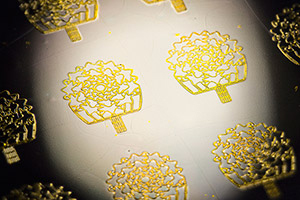 The original sensor fabrication process involved 10 steps, five of which had to take place in a clean room. Image credit: Jacobs School of Engineering. In order to make the sensors more like peel-off stickers, researchers had to build the sensors essentially upside down so that their functioning part would be exposed after they were removed from the wafer. The process requires no chemical solvents, which means the sensors can be peeled off with any kind of adhesive, from adhesive tape to a lint roller.
Coleman’s team also showed that the sensors could be made on a curved film typically used to manufacture flexible printed circuits and the outer layer of spacesuits. Researchers were able to easily peel off the sensors from the curved film without compromising their function.
To demonstrate that the sensors they built with the new fabrication process are functional, researchers placed a sensor on a subject’s forehead and attached it to an electroencephalography machine. The sensors were able to detect a special brain signal present only when the subject’s eyes were closed, a classic electroencephalogram testing procedure. The researchers also demonstrated that these sensors are able to detect other electrical rhythms of the body, such as the heart’s electrical activity detected during an electrocardiogram or EKG.
The new fabrication process will allow bioengineers to broaden the reach of their research to more clinical settings. It also makes it possible to manufacture the sensors with a process similar to that of a printing press, says Coleman.