MIT engineers develop a programmable fiber
Marie Donlon | June 03, 2021Engineers from Massachusetts Institute of Technology (MIT) have developed a fiber with digital capabilities that can be used to collect, store and analyze data using a neural network.
To create the digital fiber that is capable of storing and processing data digitally, the MIT team positioned hundreds of square silicon microscale digital chips into a preform used for creating a polymer fiber. The team precisely controlled the polymer flow to create a fiber with an uninterrupted electrical connection between the chips over tens of meters
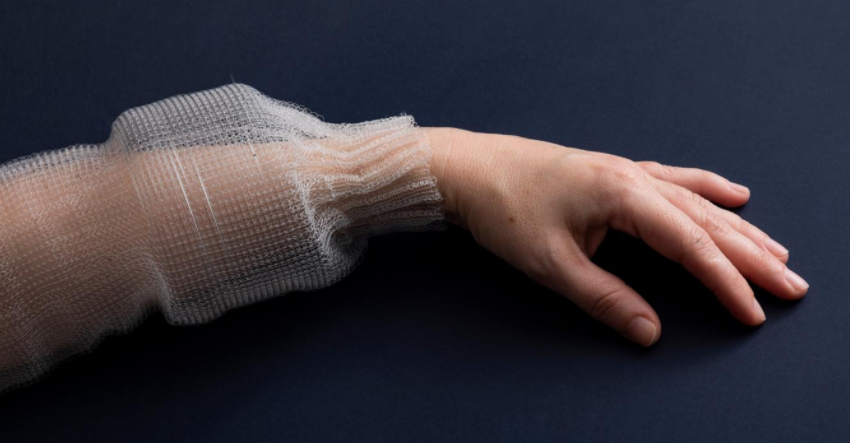 MIT researchers have created the first fabric-fiber to have digital capabilities, ready to collect, store and analyze data using a neural network. Source: Anna Gittelson/Roni Cnaani
According to the MIT engineers, the end result is a thin, flexible fiber that can pass through the eye of a needle, be sewn into the fabric of clothing, be washed roughly 10 times without degrading and store information. The fiber also includes within the fiber memory a neural network of roughly 1,650 connections for analyzing data.
During testing of the fiber, MIT researchers were able to write, store, and read information on the fiber, including a 767-kilobit full-color short movie file and a 0.48 megabyte music file.
So far, electronic fibers have been largely analog, carrying a continuous electrical signal, versus digital, wherein discrete bits of information are encoded and processed in 0s and 1s.
"This work presents the first realization of a fabric with the ability to store and process data digitally, adding a new information content dimension to textiles and allowing fabrics to be programmed literally," explained Yoel Fink, a professor of material sciences and electrical engineering, a Research Laboratory of Electronics principal investigator and the senior author of the study.
Once sewn into a shirt or other clothing, the digital fiber could also be used to detect hidden patterns in the wearer’s body, monitoring physical performance, medical inference or early disease detection.
The digital fiber is detailed in the journal Nature Communications.