Metal-free battery degrades on demand
S. Himmelstein | May 12, 2021Demand is ever increasing for lithium-ion batteries to power and store energy for electronic devices and electric vehicles, resulting in growing consumption of requisite mineral components and attendant environmental issues. Only a small percentage of li-ion batteries are recycled, leading to increasing volumes of waste and pressure to procure virgin materials. These issues may fade with a new, metal-free battery technology platform based on a polypeptide organic radical construction.
The design developed at Texas A&M University uses redox active polypeptides, which are electrochemically active chains of amino acids, to assemble the battery's two electrodes. These components can be degraded on demand in acidic conditions to generate building blocks and degradation products.
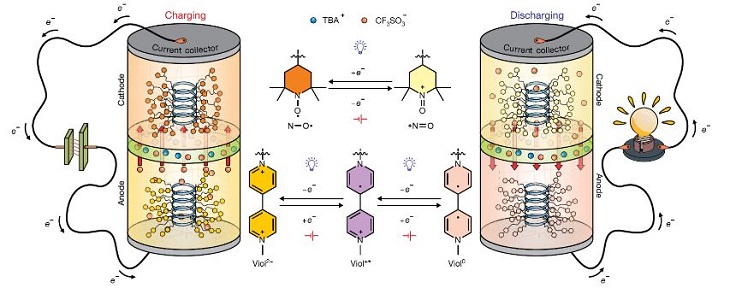 Schematic of a polypeptide-based organic radical battery and the reactions that occur during charging and discharging are shown on the left and right, respectively. Source: Karen Wooley et al./Texas A&M University
During laboratory tests, the polypeptide battery reached a maximum charge capacity of 37.8 mA/hour/g, and active components degraded on demand in the presence of acid to regenerate the starting amino acids and other foundation materials. The degradable battery performed about one-third as well as a conventional li-ion battery but about as well as other organic polymer batteries.
The researchers consider the metal-free, all-polypeptide organic radical battery described in Nature as an important advance toward sustainable, recyclable batteries that minimize dependence on strategic metals.