Team improves the speed of 3D printing
Marie Donlon | March 22, 2021Researchers at the University at Buffalo have developed a technique for improving the speed of 3D printing hydrogel, ultimately paving the way for rapidly 3D-printing human tissue and organs.
Using a 3D-printing method called stereolithography — wherein objects are 3D printed layer by layer via a photochemical process where light causes chemical monomers and oligomers to cross-link together and form polymers — hydrogel models are 3D printed 10 to 50 times faster than traditional 3D-printing approaches.
“Our method allows for the rapid printing of centimeter-sized hydrogel models. It significantly reduces part deformation and cellular injuries caused by the prolonged exposure to the environmental stresses you commonly see in conventional 3D printing methods,” explained the study’s co-lead author, Chi Zhou, PhD, associate professor of industrial and systems engineering.
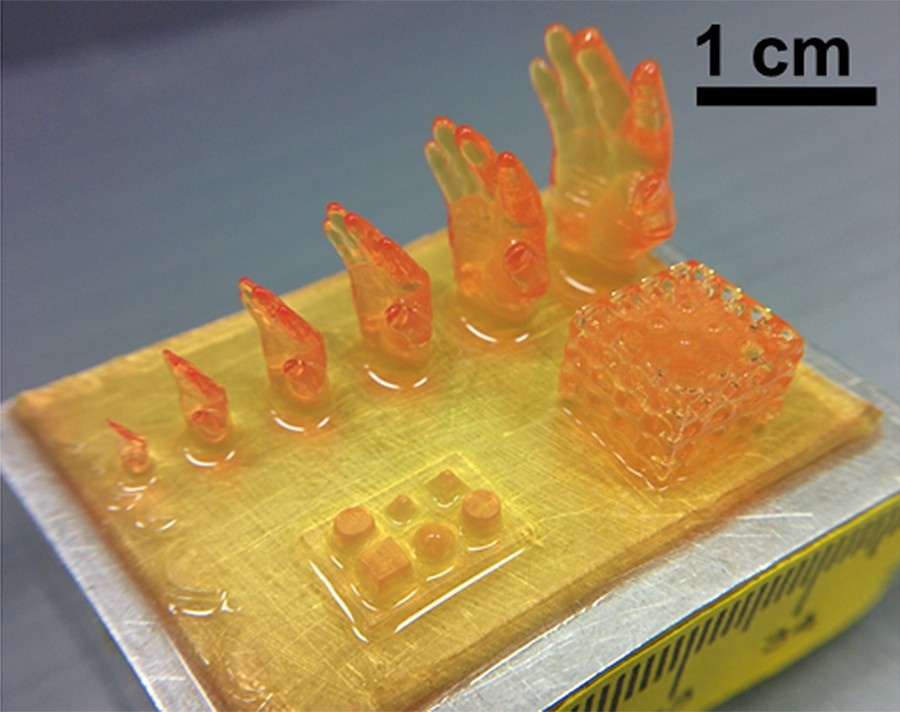 Researchers made a series of small scale models of the 3D-printed hand, as well as other figures. Source: University at Buffalo.
The researchers believe that the technique is appropriate for printing cells featuring an embedded blood vessel network and have patented the technology through their startup Float 3D.
To see the 19-minute process of 3D printing a hydrogel model hand, sped up to seven seconds, watch the accompanying video that appears courtesy of the University at Buffalo.
The research is published in the journal Advanced Healthcare Materials.