
Polymer solar cells: A flexible and efficient photovoltaic technology
N. Mughees | March 12, 2021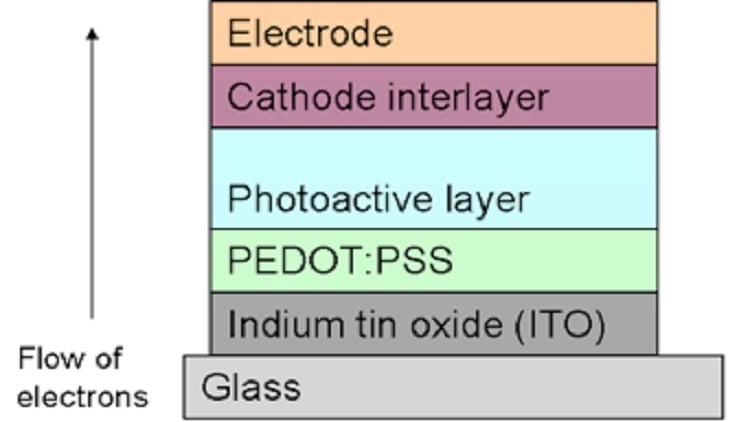 Figure 1: Structure of a typical polymer solar cell. Source: Creative Commons License
Polymer solar cells have gained popularity over their more traditional silicon-based counterparts because of advantages such as low manufacturing expenses, greater flexibility, lower weight, less impact on the environment associated with fabrication and operation, effortless deployment with other products and short energy payback period. Polymer solar cells are constructed using organic substances and are a kind of flexible solar cell. Polymers are big, stable structural modules, which generate electricity by harnessing sunlight through the photovoltaic effect.
Figure 1: Structure of a typical polymer solar cell. Source: Creative Commons License
Currently, available commercial photovoltaic cells are developed from purified, superior silicon crystals similar to the substances utilized in manufacturing integrated circuits and computer chips. Their non-economic design and complex manufacturing method have contributed to interest in alternative methods and materials. Light-weighted polymer cells have demonstrated application in automatic sensors and their translucent design has also contributed to deployment in windows, walls and flexible products.
Operating mechanism of polymer solar cells
The operating mechanisms of inorganic and organic solar cells vary greatly but are similar in that each absorbs photons that produce an exciton — a bonded pair of an electron and a hole. Imagine this exciton, like an electron in an atom of hydrogen, as an electron circling its corresponding hole. However, the ionization energy of hydrogen is very large (13.6 eV), while the energy needed to disassociate an exciton is quite lower and relies on the shielding impact of the medium's dielectric constant. Therefore, the strong dielectric strength of inorganic silicon semiconductors, with a dielectric constant of approximately 12, allows excitonic bond energy to be around 0.1 eV, whereas the small dielectric constant of polymers of about 2 makes separation of the electron-hole pair difficult owing to the bonding energy of the order of 1 eV.
Structurally, a polymer cell is composed of a translucent substratum (glass or plastic) on which a thin translucent conducting film of indium ton oxide (ITO) is mounted as shown in Figure 1. A film of the 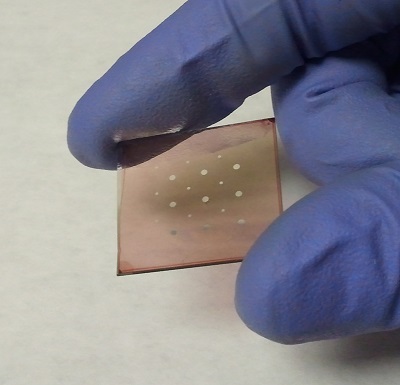 Figure 2: A small polymer solar cell. Source: Creative Commons Licensesemiconducting p-type plastic poly(3,4-ethylenedioxythiophene) or PEDOT, is then applied. This polymer has sufficient binding energy to absorb photons and generate the bound electron-hole pairs or excitons. The excitons then move to the heterojunction present between an n-type semiconducting plastic and PEDOT, carrying energy and not charge since they are electrically neutral with no net charge. Here, the internal electric field separates them with the electrons being inserted into the n-material and gradually navigate a path to a metal electrode. At the same time, the separated hole stays in the PEDOT layer and migrates to the ITO electrode.
Types of polymer solar cells
Depending on the cell configuration, several different kinds of polymer solar cells can be assembled. Even though each configuration has many advantages and drawbacks, inverted solar cells and bulk heterojunction solar cells are the most preferred forms.
In bulk polymer heterojunction solar cells, the combination of organic semiconductor materials from the donor and acceptor is generated as a fine layer. As a background check, the donor atoms have electrons in excess in their valence shell to donate them to other atoms that are deficient in them, for example, acceptor atoms. The mixture of two separate charge carriers greatly improves the layout area, which increases the efficiency of this type of polymer solar cell due to enhanced exciton formation. Some researchers have achieved an efficiency of up to 10% for this type.
The inverted polymer solar cells are also one of the most desirable architectures when it comes to protection. The shift in the electrode’s location is sufficient to create an inverted cell in a regular bulk heterojunction or bilayer solar cell. Acceptor molecules that are quite susceptible to moisture and oxygen, like fullerene derivatives, are thus preserved in the translucent conducting layers of the solar cell. Translucent conducting layers that are used as substratum are typically mounted on polyethylene terephthalate or glass in the commercial solar cell market.
The inverted structures can provide stronger protection against harmful substances in the air without encapsulation for the acceptor atoms, which remain between the translucent conducting layer and hole conveying material. High work function oxides are being employed in new research as a cathode and the low work function metals are being utilized as an anode. Protection is not their only forte, as they have also shown quite good performance with an efficiency of up to 10%. It is worth noting that typical polymer solar cells have efficiencies in the range of 6% to 9%, so attaining 10% efficiency is quite the achievement.
Conclusion
Due to their versatile and low-cost fabrication methods, polymer solar cells are a potential candidate for solving the cost problem of widely available Si-based cells. The strength of polymer solar cells is that solution-processed coating methods could be utilized for roll-to-roll manufacturing. They are inexpensive, compact and portable, and since they are solid-state devices, there is no requirement for water or electrolyte to ensure operation.
Furthermore, different researchers around the world are designing new materials with various features and functionality and advancing cell architectures to increase performance and stability of polymer solar cells. Currently, these cells have reached an efficiency of around 13%, but it is still quite lower than the 20% efficiency of current commercial photovoltaics. However, due to other advantages and continuous research, polymer solar cells are about to join the industry to address energy challenges.
Eventually, people can have portable, flexible solar cells printed on their umbrellas, bags or cars.



