
Better Organic Solar Cells Made with Microfossils
S. Himmelstein | October 20, 2017Organic solar cells represent a lower-cost alternative to conventional solar energy technologies. Their development is currently constrained by the use of thin active layers of 100-300 nanometers, which limits conversion efficiency.
A possible materials solution is derived from the unlikely field of paleontology: fossilized diatoms. The 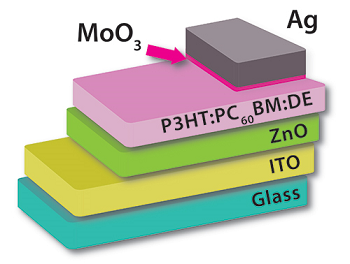 Structure of the polymer solar cell. Source: Yale Universitynanostructured silica walls characterizing these abundant phytoplankton have been optimized for light absorption through millions of years of adaptive evolution. Recognizing that the silica structures are known to trap and scatter light to enable photosynthesis, researchers incorporated diatomaceous earth into polymer solar cells to boost scattering and increase power conversion efficiency.
Dispersing diatoms throughout the active layer of the solar cell reduced the amount of the material needed for the active layer by 36 percent and increased power conversion efficiency by 30 percent.
The research team says that by using different species of diatoms and tailoring them to the right size, some of the better donor-acceptor polymers can also be applied for better performance.
Scientists from Yale University, NASA, Princeton University and Lincoln University participated in this research.
That is entirely fascinating! I wonder if DE would be of interest in phonon energy conversion as well?