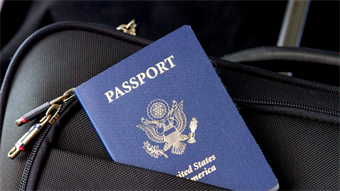
Ophthalmology tool can also be used to detect passport forgeries
Marie Donlon | February 22, 2021A team of researchers from the U.K.’s University of Kent are using optical coherence tomography (OCT) imaging technology to distinguish legitimate travel documents such as national ID cards and passports from counterfeit travel documents.
OCT imaging — which is non-invasive imaging typically employed by ophthalmologists that relies on light waves to view the distinctive layers of the retina — can reportedly be used to detect passport, national ID and other travel document forgeries via sub-surface analysis.

Typically secured with polycarbonate layers or hologram images, current passport and other travel document iterations are still vulnerable to counterfeiting thanks to the growing sophistication of computer technology. However, because efforts to counterfeit these documents also impact a document’s inner structure, the researchers determined that OCT technology could detect such attempts non-destructively.
According to the research team, using OCT imaging to perform quantitative, high-resolution sub-surface analysis on such documents could reveal forgeries in roughly 10 seconds.
Calling passport fraud a threat to global security, the University of Kent researchers believe that OCT imaging technology could also be appropriate for a host of applications including forensic science and criminal investigations.
The research — titled Sub-surface characterisation of latest-generation identification documents using optical coherence tomography — appears in the journal Science & Justice.