Watch: Low-cost OCT system expands the field for eye scans
S. Himmelstein | July 05, 2019Optical coherence tomography (OCT) imaging has evolved as the standard of care for the diagnosis of many retinal diseases including macular degeneration and diabetic retinopathy. While the high cost of OCT equipment has primarily confined these examinations to larger health facilities, the diffusion of this diagnostic technology 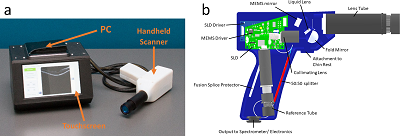 a) Complete low-cost OCT system showing PC, touchscreen and scanner. (b) Detailed composition inside the low-cost OCT handheld scanner. Source: Duke Universityinto more resource-limited areas might be accelerated by the design of a low-cost, portable retinal scanner by Duke University researchers.
The compact OCT unit is 15 times lighter and smaller than current commercial systems, and includes components costing less than a tenth the retail price of such a system. Initial clinical trials demonstrated image quality comparable to that of expensive retinal scanners and sufficient for diagnostic purposes.
The reduced cost and size were realized with 3D-printed components and off-the-shelf parts to design the spectrometer and handheld scanner. The prototype weighs 4 lb, considerably less than a 60 lb system found in eye clinics, and was assembled at a material cost of just over $5,000. A conventional OCT imager can incur costs in excess of $100,000.
To compare the images produced by both machines for 60 patients, the researchers used contrast-to-noise ratio — a measure often used to determine image quality in medical imaging. The results reported in Translational Vision Science and Technology show that the low-cost, portable OCT scanner provided useful contrast that was only 5.6% less than that of the commercial machine, which is still good enough to allow for clinical diagnostics.