Scientists to prevent quantum computers from overheating with new valve
Engineering360 News Desk | February 01, 2021To control the heat inside high-performing quantum computers, researchers from the University Grenoble Alpes and University of Turku, Finland, have constructed a single-quantum-dot heat valve, demonstrating gate control of electronic heat flow in a thermally biased single-quantum-dot junction.
To control the amount of heat that flows across a quantum dot junction while simultaneously allowing for the flow of a specific amount of electric current, the team linked a gold nanoparticle junction between two metallic contacts. Because the nanoparticle is so small it can intervene on one energy level while behaving as a larger artificial atom would with multiple accessible energy levels.
"By properly tuning the external parameters it is possible to allow the electrons in one of the contacts to flow through only one of the levels of this artificial atom and reach the other contact," said Nicola Lo Gullo, one of the researchers involved in the study. "The single-level quantum dot therefore acts as a bridge between the two metallic contacts."
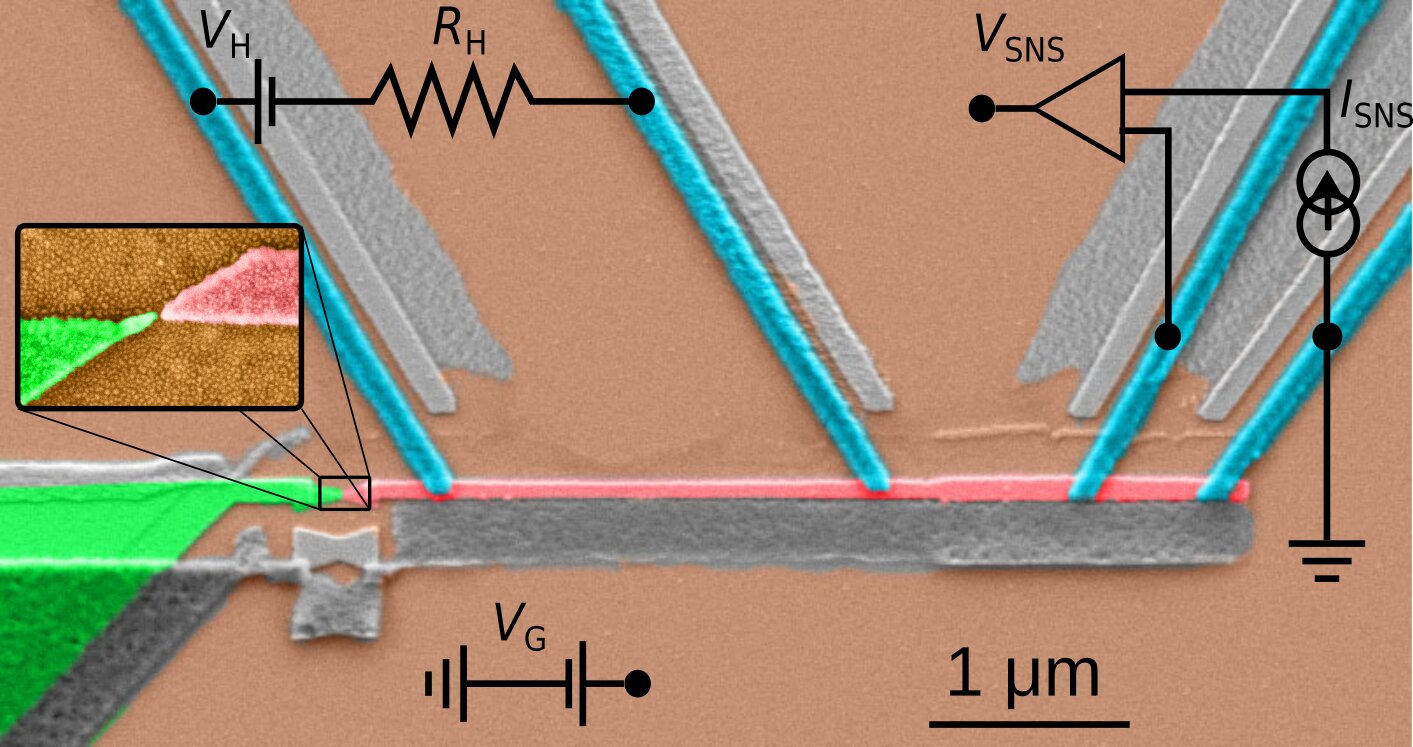 A Scanning electron microscope (SEM) image of the researchers’ experimental setup. Source: Dutta et al.
According to the researchers, electron temperature maps measured in the area surrounding the junction (as a function of the gate and bias voltages applied to the device) demonstrate clear Coulomb diamond patterns that suggest a maximum heat transfer at the charge degeneracy point. Reportedly, the nontrivial bias and gate dependence of the heat valve occurs due to the quantum nature of the dot at the core of the device and its coupling to leads.
Going forward, the heat valve could potentially improve the reliability and safety of quantum devices by reducing the risk of overheating.
The research appears in the journal Physical Review Letters.