
Point: Climate change data is wrong or exaggerated
Zak Ajia | October 18, 2020 Source: Adobe/sveta
Editor's note: This is part of GlobalSpec's Point/Counterpoint series of articles, which seeks to foster constructive discussion around divisive topics in technology and science. Read this article's companion piece, Counterpoint: The data is clear - climate change is real and happening.
Climate change is a dominant political, social and environmental force in the 21st century. Climate change proponents believe that the world's atmosphere has increasing variability and volatility. In their view, the aggregate result is a climate that is increasingly warm, and potentially dangerous from resultant sea level rise, droughts and storms. And the cause is additional atmospheric carbon dioxide from human behaviors.
Some estimates state that 97% climate scientists agree on the above facts. However, the remaining 3% is a boisterous minority, that cite some of the following evidence as reasons for disbelief. Some believe in a "global cooling," others believe the risks are exaggerated, and another cohort believes humans are not the cause.
These are positions that have drawn a few notable scientific minds. One of those being Roy G. Spencer, award-winning meteorologist and researcher at University of Alabama - Huntsville. In his 2018 book, "Global Warming Skepticism for Busy People," he wrote, "Catastrophic climate change is a matter of faith—not science. Another way to phrase it is, the scientific support for a small portion of predicted warming is pretty good, while for strong warming it is extremely speculative."
Here is some of the leading evidence against climate change.
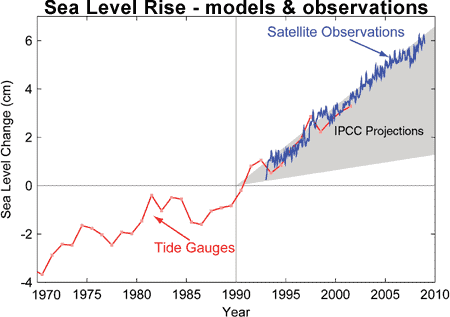 Figure 1. Sea level models vs. observations. Source: IPCCClimate change models are not enough
Scientists use climate change models to understand global weather trends. Climate models are mathematical equations based on environmental research used to describe the interactions between the physical, chemical and biological properties in the atmosphere, ocean, land, sea and polar regions. In terms of climate change, they are used for analyzing how the global climate will react to increasing greenhouse gas concentrations.
Many climate change deniers take issue with such models, and cite records errors. The errors can be due to human mistakes encountered when gathering, storing or interpreting data gotten from the earth’s physical, chemical and biological resources.
It is not unusual for climate change projections to vary widely across climate models, and this invokes questions about their reliability. Figure 1 shows global sea-level rise projections from 1990-2010 of two different climate models. Both projections were produced from climate models obtained from tide gauges and satellite observations, indicated in red and blue bands respectively. The two climate models’ projections of global sea level rise were erroneous and differed from reality – the IPCC climate models represented in gray bands.
Temperature record
Climate change predictions rely heavily on temperature data. This data is recorded from approximately 30,000 weather stations spread out throughout the world.
Climate change opponents often cite this data as unreliable, and indeed some studies have found errors with weather station location. Too often stations instruments are located for convenience – say in the asphalt parking lot of a university's science department – than being located for data integrity.
In a study conducted at the National Climatic Data Center on temperature data gotten from weather stations in poor locations around the world found that weather stations that are "poorly sited actually showed slightly cooler maximum daily temperatures compared to the average.”
Considering that gradual temperature change is a key tenet of climate change, this is an easy way to discredit climate change data.
Effects of increased CO2
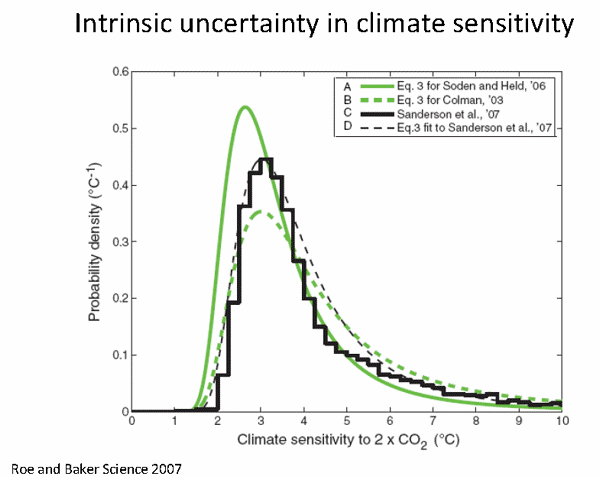 Figure 2. Uncertainty in climate sensitivity. Source: Roe and Baker Science
It was observed in the IPCC fourth assessment report that doubling the Earth's CO2 would increase the planet’s temperature by a small margin, likely in the range of 2 to 4.5° C, with a best estimate of 3°.
This is counter to some climate change theories that posit higher estimates in similar time frames. First, a doubling of atmospheric CO2 is a generous assumption for the amount of CO2 produced. And this also indicates that climate change may be happening at a slower pace than some studies suggest, meaning that there is more time for further, potentially more accurate, investigations and action plans.
CO2 comes from warmer temperature
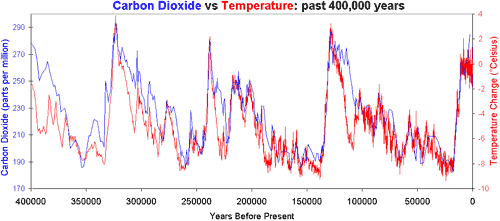 Figure 3. Carbon dioxide and temperature temporal trends. Source: Vostok Antarctic ice core records for carbon dioxide concentration (Petit 2000) and temperature change (Barnola 2003).s
Thanks to Antarctic ice cores, researchers are able to study the relationships between atmospheric CO2 and temperature for the last 400,000 years of Earth's history. This research has largely concluded that CO2 levels is not the primary contributor to climatic temperature rise.
Some data suggests that initial temperature rise occurred before CO2 increases, which was fueled by the Earth's natural celestial mechanics. As oceans rose, they released additional CO2, which continues in phases today. Atmospheric CO2 is both a cause and effect of climate change, and humans in this case are not the drivers of climate change, but rather a passenger.
Conclusion
Among the scientific community, climate change is practically a given. However, there is ample room for improvement in climate change research, as it has become error prone. It is research that thousands or millions are working on, and the high variability of the predictions and data quality lead to questions in the theory's overall validity.


One only has to look at the last 70 years of climate predictions, that didn't come true, to realize that any predictions of the future are unreliable...
In reply to #1
Tell that to users of Gantt charts....
In reply to #5
What's that supposed to mean? Show us a Gantt chart that proves your point.
Good analysis of the Vostok ice core data, which was shown in a very condensed graph, has shown an 800+/-200 year lag between the rise in temperature and the following rise in atmospheric CO2. The analysis points to CO2 being forced out of the oceans by their temperature rise, as well as other factors. There is one problem with applying that data to claim that rising CO2 levels do not precede or cause rising temperatures--the current CO2 levels are far above any of the data in the 400,000 year Vostok cores. Therefore we invite trouble for trying to extrapolate these data to debunk or deny the possibility/probabil
Do we want to deny the possible link between CO2 levels and climate change? If we find ways to change our habits we will be taking steps that mimic the oath of doctors to "first do no harm". So working towards conservation, switching away from fossil fuel consumption, and many other steps may be wise, regardless of the direction of climate change science.
Well, this article was entirely unconvincing. The first chart shows that IPCC models varied from right on the money to underestimating rise. This would not indicate dramatic/catastrophi
It was good that you included one dissenting scientist, but there are lots more. An example:
https://www.climated
You claimed that the dissenters are boisterous. Show us the evidence for that if you can. Your inclusion of the ice-core samples was good, but you ignored it in your conclusions. This series of articles reminds me of a rigged election or a rigged debate like the one between Trump and Biden
Few if any believe that that the world is not warming. We are, after all, coming out of an ice age. 3/4 of the US was once covered by ice. I for one don't want to go back to that. The question is how much humans are contributing to it. No doubt some. A case in point: The arsonists that started several fires in California and Oregon were in fact human. And the corrupt police and judges that let them go are also human.
No one is denying "climate change", the question really is whether or not it is "man driven".
IMHO, the charts in this column show wild fluctuations of both carbon dioxide and temperature over the last 400,000 years and do not present any evidence of mankind's participation in those changes. This leads to the obvious (at least obvious in my mind) conclusion that these changes are natural and reasonably cyclical.
To that end, I can't see how mankind can actually change or even influence these natural cycles and therefore I'm not in the least worried about anthropogenic climate change; I am however worried about the political consequences of too much pursuit of "stopping" climate change.
In reply to #7
TBC,
I agree that the climate is changing and with your legitimate question about whether it is anthropogenic or not. I strongly prefer the phrase "climate change" over "global warming" because it better describes what is happening.
The 400,000 year Vostok glacial core CO2 & temperature data do not show any time when the CO2 level was over 300 ppm, yet now it is at or above 400. I suspect we will be (or are) seeing an overlay of naturally-occurring fluctuations with human-caused ones. In saying this, I am assuming that you would agree that the recent (50-100 year) rise in these levels correlates very well with the quantity of fossil fuels burned in that period of time.
The Vostok data generally showed a lag between the temperature rise and the CO2 rise. This supports the assumption of a naturally-occurring fluctuation caused by changes in insolation magnitude. The recent observed temperature changes appear to be either concurrent with or after the CO2 changes, instead of preceding them by 100+ years. This anomaly strongly suggests careful and open-minded consideration of possible causes, one of which is anthropogenic climate change.
I agree that "political consequences of
too muchpursuit of stopping climate change" can be a real problem. I would also agree with those who say that we should modify our break-neck and reckless pursuit of consumption regardless of costs. Our present rate of fossil fuel consumption is not sustainable in terms of available resources--granted that we continue to discover resources but there is a limit to the ability to find and extract them in an environmentally-safe--JMM