
Counterpoint: The data is clear - climate change is real and happening
Zak Ajia | October 18, 2020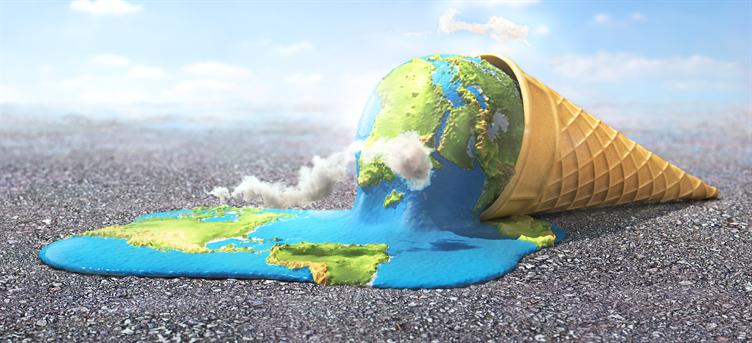 Source: Adobe/sveta
Editor's note: This is part of GlobalSpec's Point/Counterpoint series of articles, which seeks to foster constructive discussion around divisive topics in technology and science. Read this article's companion piece, Point: Climate change data is wrong or exaggerated.
Climate change is not a new idea, although it has gained more widespread traction among both the scientific and general communities in the last 30 years. That's because the data speaks for itself - and it overwhelming says that climate change is not only happening today, but has been occurring on an unprecedented scale since the late 19th century.
What follows is some of the most clear evidence in support of climate change theory.
Greenhouse gas effects
 Figure 1. Global CO2 emissions from fossi fuels, 1751-2012. Source: EPI from BP; CDIAC; USGS
Greenhouse gases such as water vapor (H2O), carbon dioxide (CO2), methane (CH4) and nitrous oxide (N2O) are naturally occurring in the environment, and any significant increase in their quantities increases heat in the atmosphere. That is because these molecules radiate sun rays and thermal energy, leading to global warming and climate change.
An increase in the concentration of greenhouse gases in the environment is believed by environmental scientists to be caused by human activities, primarily the burning of fossil fuels. Figure 1 illustrates strong correlation between the burning of fossil fuels and carbon dioxide levels in the environment.
Apart from fossil fuels, other human activities such as agriculture usage, production of waste and deforestation contribute to climate change as well. For example, the clearing of agricultural lands for non-agricultural uses has increased in the last two decades and this has reduced the ability of plants and trees to absorb carbon dioxide from the atmosphere to help regulate the Earth’s temperature.
Sea level rise
 Figure 2. Global mean sea level rise. Source: Carbon Brief
Climate change has led to glacier melts due to increased temperatures. Glacier melts have increased sea levels, threating coastal regions with rising tides and additional erosion. Also, warmer oceans are slightly less dense, meaning the same quantity of water occupies more volume.
The rise of global sea levels in the last 100 years is directly related to carbon emissions produced in the world.
Heat waves
The American Meteorological Society defines a heatwave as “a period of abnormally and uncomfortably hot and usually humid weather.” Heatwaves have been rampant on a global scale in the past two decades. For example, there were heatwaves in Europe and Russia in 2003 and 2011, respectively. In 2017, southern Europe experienced an unprecedented heatwave known as Lucifer, the worst experienced since 1900.
The World Meteorological Organization asserts that the two hottest years on record occurred in 2019 and 2016, respectively. And since the late 20th century, every decade on earth has been warmer than the previous (Figure 3).
 Figure 1. Global mean temperature differences, 1850-2025. Source: WMO
Droughts and floods
As greenhouse gas emissions and global temperatures continue to rise, the Earth’s water evaporation increases. The increased evaporation rate makes land areas drier, leaving less moisture in the soil but more in the air. For example, The World Meteorically Organization reported that the extreme droughts in Africa in 1975, 1983 and 1984 contributed to more than 650,000 deaths.
Flooding events have been reoccurred with more frequency in the last three decades. As temperatures become warmer due to global warming and climate change, the atmosphere holds more water. This moisture is eventually released in the form of extreme rainfalls, leading to floods. Since 1901, the U.S. climate is 1.8° F warmer, and also 4% wetter overall. The Northeast U.S. is experiences storms with 27% more moisture; meanwhile the unprecedented 2016 rainfall in Louisiana that led to widespread flooding is 40% more likely and 10% more intense because of climate change.
Mitigation
According to the data, climate change has been occurring for decades, meaning that potential remedies need to be instituted immediately. Various technologies can help make progress to reduce potential future climate variations.
According to the International Energy Agency, over 80% of the energy consumed in the world comes from fossil sources. Fossil-based energy accounts for two-thirds of the world’s greenhouse gases. The use of renewable energy technologies such as photovoltaics, wind turbine and geothermal heat pumps are vitally important because they do not emit carbon and solve energy needs.
A significant portion of transportation is also powered by fossil fuels. In 2010, the EPA pegged that 14% of greenhouse gas emissions were produced by this sector. The transition of personal vehicles to hybrids and EVs could save immense emissions, and serve as a stepping stone for wider transportation electrification.
Waste savings and recycling represents another opportunity. The World Bank stated that 2.01 billion tonnes of food waste was produced globally in 2016, and that total would grow by 70% by 2050 unless action was taken to reduce waste and improve recycling. Waste from landfills is responsible for 5% of total greenhouse gas emissions.
Waste in landfills is broken down by bacteria and produce high levels of methane and CO2. Methane is 21 times more powerful than carbon dioxide at warming the atmosphere. The benefits of greater proliferation of recycling technologies, and sanctioned recycling programs, cannot be overstated.
Similarly, water conservation could decelerate climate change. In some regions, up to 20% of electricity and 30% of natural gas is used to drive to drive pumps and systems for water utilities. In California, curbing water needs by 25% would create the same amount of cold water energy (for transfer and delivery; not heating) savings as those created by the state's four utility-run electricity savings programs.
Summary
A 2015 study, Learning from mistakes in climate change, perhaps sums it up best. Up to 97-98% of scientific studies support human-caused climate change. And those studies that refute climate change are either purposefully or accidentally flawed. Meanwhile, only 47% of Americans believe scientists have reached this conclusion.
The consensus gap exists almost exclusively in among general laypeople – not the experts who are creating and analyzing the research.


Any of these claims can be refuted with logic...While it is clear there is a gradual warming trend since the last ice age, it is not anywhere near the claims being made today....It is still not clear what the future holds that could be deemed reliable information...The Earth may still balance out the effects of increasing co2, we are a lot closer to the minimum level that keeps plants growing at around 180 ppm than we are to any known maximum level....Only a few years ago scientists were predicting an ice age, then they were saying NY city would be under water by 2000...yet nothing has changed...I live at the edge of the ocean and I see no sea rise in the last 65 years...If the sea were rising don't you think beachside properties would be plunging in value? If you ask me this hoopla, like hoopla of the past, will be forgotten and a new threat will be in the news....because there's always some threat being touted...If you ask me the biggest threat is scientists predicting doom....now that's something you can always count on ...
Although I agree with the basic assertion that humans are causing undesirable deviations in the earth's climate, I wish to point out an unsupported statement at the beginning of this paper: "Figure 1 illustrates strong correlation between the burning of fossil fuels and carbon dioxide levels in the environment." The figure and the underlying paper linked to it give the quantity of CO2 released by fossil fuel burning but do not give the easily-made correlation of this with actual CO2 levels in the atmosphere (the Mauna Loa data). Shame on you for this elementary error that a qualified scientist would have avoided. Put up a graph showing these two data curves together!
--JMM
Concerning droughts and history, The Chinese famine in 1907 lost 25 million people, the Northwest Chinese famine (1928-1930) lost 3-10 million, The Russian famine in 1921 lost 5 million, the Indian famine/drought (1896-1897) lost 1 million, the Northern Chinese drought/famine (1876-1879) lost 9-13 million, etc.
Concerning sea level rise - it should be taken in perspective. According to Wikipedia, "Over geologic time sea level has fluctuated by more than 300 metres, possibly more than 400 metres... The current sea level is about 130 metres higher than the historical minimum."
https://en.wikipedia
This says we are on the low end of a naturally occurring cycle. Instead of trying to stop it, we should be trying to adapt to it. Adaptation has been the key to survival for millions of years.
In reply to #4
I can remember as a youth, riding and later driving the coast highway in California and seeing the very clear evidence of much higher sea levels. Now how much of that was due to earthquake movement and how much to sea level changes I don't know.
--JMM