Testing techniques for tracking coronavirus in untreated wastewater
S. Himmelstein | August 20, 2020The use of assays based on nasal swabs and other biological media to track the spread of COVID-19 can be augmented by wastewater monitoring. Past research has demonstrated the use of ultrafiltration and other methods to concentrate nonenveloped enteric viruses from untreated wastewater. The feasibility of applying these same approaches to the detection of SARS-CoV-2, an enveloped virus, was evaluated.
Researchers added murine hepatitis virus (MHV), an enveloped virus related to SARS-CoV-2 but without a safety risk to humans, to untreated municipal wastewater samples. The ability of seven methods commonly used in testing for nonenveloped viruses to recover and concentrate the MHV was studied. Recovery was 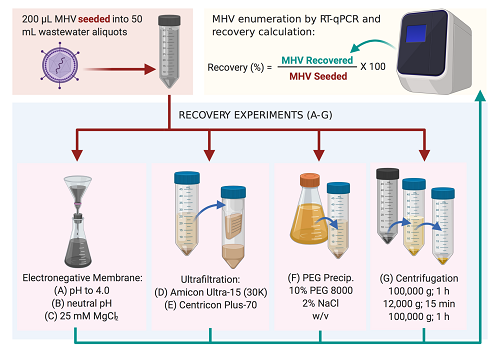 Of the methods used to recover MHV, the most successful was method (C), followed by method (B). Source: Warish Ahmed et al.indicated by reverse transcription-quantitative polymerase chain reaction techniques.
The highest recovery was observed after treating a sample with magnesium chloride and then filtering out the virus on a negatively charged membrane. A similar treatment scheme without magnesium chloride pretreatment posted the next highest recovery of viral material. These techniques also offer advantages of a quick, one-hour processing time and the use of widely available and inexpensive equipment and reagents. The methods with the worst recovery efficiency included an adsorption-extraction process with acidification, followed by polyethylene glycol precipitation.
The next step would be to test the adsorption extraction concentration methods, with and without magnesium chloride pretreatment, in samples collected from areas where the pandemic is prevalent.
The study was conducted by scientists from Commonwealth Scientific and Industrial Research Organisation (Australia), University of Notre Dame, Bangor University (U.K.), South Australian Health and Medical Research Institute, University of Yamanashi (Japan), Institute of Environmental Science and Research Ltd. (New Zealand), U.S. Environmental Protection Agency, Queensland Alliance for Environmental Health Sciences (Australia), University of South Florida and Hokkaido University (Japan), and is published in Science of The Total Environment.