Resonant sensor developed for mail-in, no-touch COVID-19 test
S. Himmelstein | August 19, 2020A contactless, fast-scan test for COVID-19 is under development at Iowa State University. The diagnostic kit is expected to cost the user about $1 and would provide for at-home testing.
The touch-free diagnostic requires no personal protective equipment or medical professionals on-scene. Cough or nasal samples are applied to a resonant sensor printed on paper, which is then dropped off at or mailed to a collection center for evaluation with an electronic reader. The envelope containing the sample would then be 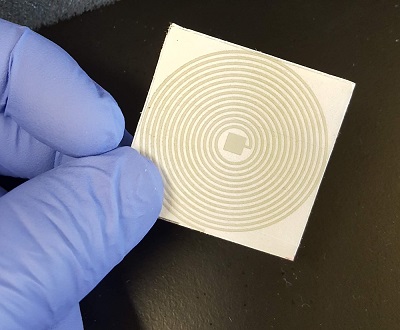 A printed, paper resonant sensor is being developed to detect COVID-19 RNA genetic material. Source: Nigel Reuel/ Iowa State Universityincinerated, still in its unopened state.
The sensor system detects RNA genetic material through toehold switches, which are a class of RNA with a hairpin loop that is unfolded upon binding with a trigger RNA, which would expose a ribosome binding site and permit interpretation of the reporter protein. Formation of reporter proteins can change the color of a sensor or the frequency of its signal.
If COVID-19 RNA is in the sample, the toehold switch would allow production of proteins that degrade a coating on the circuit, yielding a positive signal. If there is no virus RNA, there would be no protein production, and no coating degradation and therefore a negative signal. The final iteration of the sensor will probably involve multiple layers on thick paper with a top layer used to collect samples, middle layers to contain the toehold switch and bottom layers with a printed, coiled resonant circuit that can be scanned for frequencies that would indicate disease.
According to Nigel Reuel, an assistant professor of chemical and biological engineering, “This approach off-loads the burden of diagnostics from health workers, eliminates the increased use of limited personal protective equipment, and provides a better response to outbreaks.”