Watch: Shape-shifting implant materials are 3D printed
S. Himmelstein | July 14, 2020Soft structures that can reversibly change shape in response to external stimuli, such as heat or an electric current, have been 3D printed by Rice University researchers. The reactive 3D-printing method decouples printing and shape-programming steps, enabling a broad range of complex architectures and virtually any arbitrary shape changes.
The process offers potential for designing adaptive biomedical implants that can respond to external stimuli for 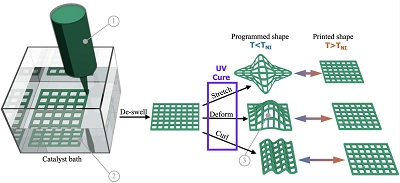 Graphic depicts the 3D printing process used to produce shapeshifting materials that may be useful to make soft robots or biomedical implants. Source: Verduzco Laboratory, Rice Universityincreased therapeutic functionality. Material is printed in a catalyst bath with a liquid crystal polymer ink formulated to define the original shape. Shape changes are then programmed through mechanical deformation and UV irradiation. Upon heating and cooling, the polymer ink reversibly shape-shifts between printed and programmed forms, respectively.
A variety of shape changes was programmed in a single printed material to demonstrate the technology. The researchers will continue to optimize the printing inks and methods to enable fabrication of unsupported structures, such as columns, and to synthesize actuators with complex architectures that empower soft robotics to transport liquids or perform other functions.