Study: Simulation of borehole ballooning may result in safer drilling practices
Marie Donlon | May 05, 2020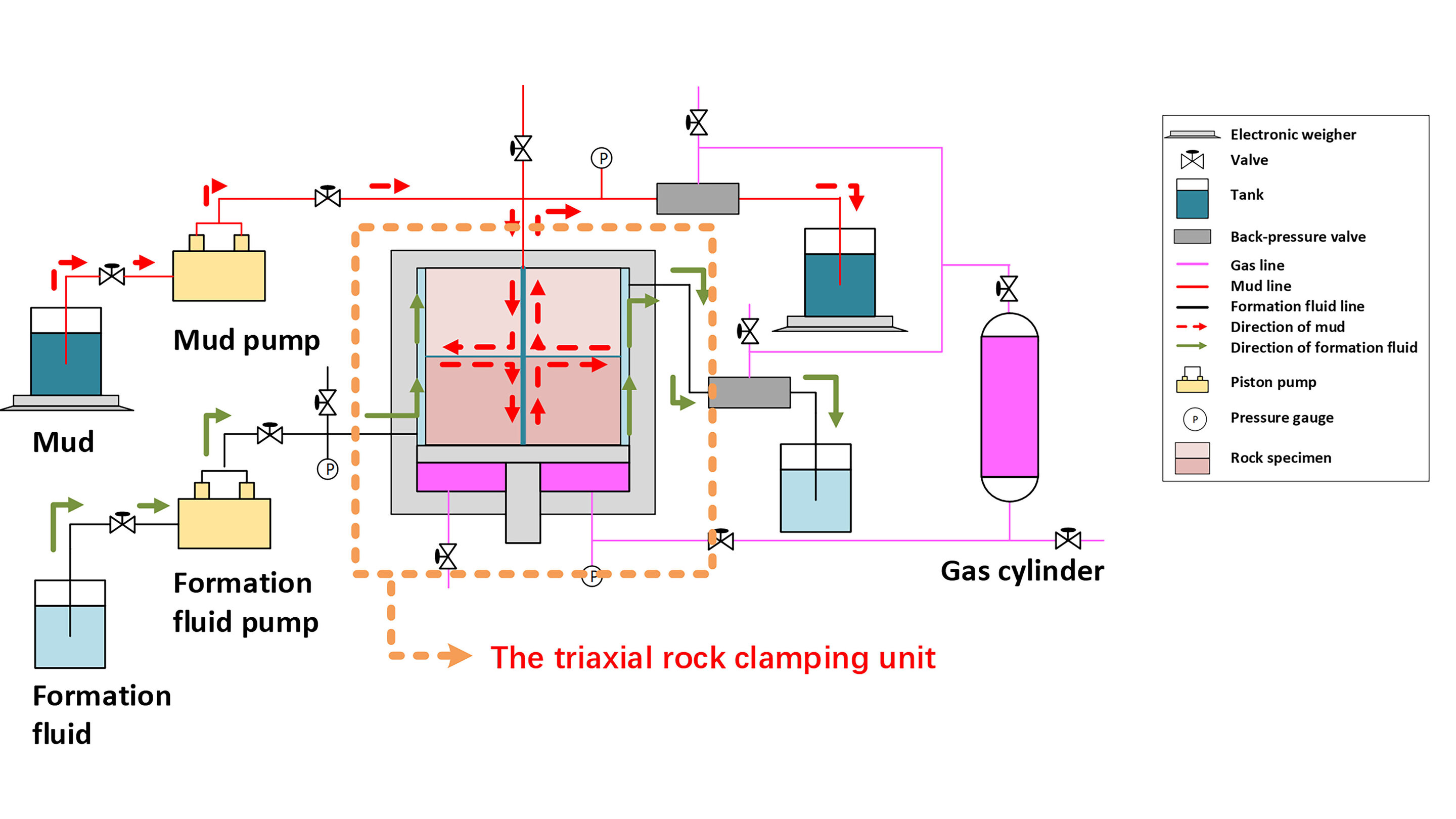 Schematic diagram of the borehole ballooning experimental device. Source: Reyu GaoA team from China University of Petroleum-Beijing has developed a device that can simulate borehole ballooning — the reversible mud gains and losses that are a byproduct of deep-water drilling — in a bid to develop strategies for preventing it.
Composed of four units — a displacement unit, a triaxial clamping unit, a back-pressure unit and a control and acquisition system — the device simulates borehole ballooning under conditions including assorted fracture opening pressures, rock types and mud circulation that are associated with irreversible damage and potential accidents.
"According to the current research, the main mechanism causing borehole ballooning is the opening and closing of the fracture network around the wellbore caused by wellbore pressure fluctuations. Therefore, based on this mechanism, we first designed the core unit of the device, the triaxial clamping unit, which can simulate the opening and closing of fractures," said study author Reyu Gao.
By simulating the problems encountered in deep-water drilling, the research team believes that they can develop responses for preventing such issues going forward.
The study appears in the journal the Review of Scientific Instruments.