Membranes take a dip to improve separation performance
S. Himmelstein | May 01, 2020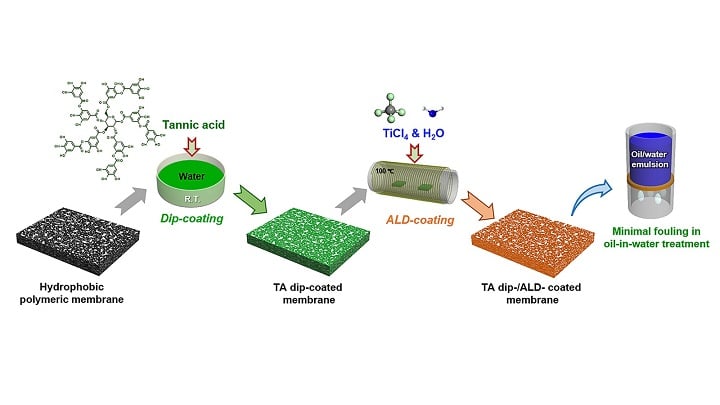 A hydrophobic polymeric membrane dip-coated in tannic acid is loaded into an ALD reactor for coating with titanium dioxide. Coated membranes display minimal fouling in oil-in-water treatment. Source: U.S. Argonne National Laboratory
The properties of membranes used for water filtration and other applications can be tailored for performance improvements by use of atomic layer deposition (ALD). However, this process of using alternating chemical vapors to deposit thin layers on a surface is not always applicable to the inexpensive materials commonly consumed for membrane synthesis. A dip-coating pretreatment technique has been demonstrated to render membrane materials more amenable to ALD and to the realization of its structural benefits.
When dipped in tannic acid, hydrophobic polymer membranes became more receptive to being coated with titanium dioxide by ALD. The pretreatment transformed the polymer into a hydrophilic, or water-attracting, material with enhanced resistance to biofouling. The membranes produced by researchers from U.S. Argonne National Laboratory, University of Chicago and Harbin Institute of Technology (China) demonstrated superior crude oil‐in‐water separation and reusability compared to untreated membranes or those treated with ALD without pretreatment.
The researchers are now working to scale up the new ALD method, which could potentially work not just with tannic acid but any liquid polyphenol and with any polymer membrane, to accommodate the processing of large area substrates.