Map pinpoints US power line vulnerability to geomagnetic storms
S. Himmelstein | April 07, 2020A geoelectrical hazard map covering two-thirds of the U.S. shows the voltages liable to be induced on the power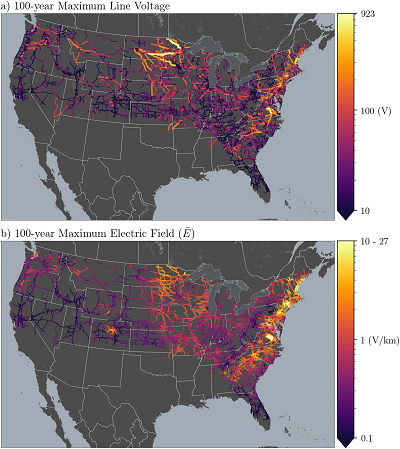 The once-per-century extreme geomagnetic storm event predictions of the (a) transmission line voltage and (b) average transmission line electric field. High hazard regions are seen along the Eastern Seaboard and in the Upper Midwest, and a hotspot is evident around Denver. Source: USGS grid in the event of a once-in-a-century magnetic super-storm. The data released by the U.S. Geological Survey (USGS) could help power companies better protect their infrastructure and reduce the risk of future blackouts.
Magnetic disturbances caused by the dynamic action of the Sun and solar wind during geomagnetic storms generate electric fields in the Earth's crust and mantle, which can interfere with the operation of grounded electric power grid systems. When sufficiently energetic, these events can produce blackouts such as the March 1989 blackout in Quebec, Canada.
Data collected by the USGS Geomagnetism Program, which continuously monitors the Earth’s magnetic field through a network of 24 ground-based observatories, were combined with the public maps of high-voltage transmission lines. The researchers observed the influence of geologic structure as an important factor affecting storm-induced voltages on the power grid.
A 100 year geo-hazard map generated by analyzing magnetotelluric survey measurements for 84 geomagnetic storms reveals a high hazard risk in the northern Midwest and the Piedmont formation east of the Appalachian Mountains due to the presence of electrically resistive rock. The Denver metropolitan area and the Pacific Northwest were also identified as regions at elevated risk: In some areas, transmission line voltages could approach 1000 V during a geomagnetic event.
The research is published in Space Weather.