Researchers construct self-regulating valves, motorless pumps using ultra-thin film
Marie Donlon | April 06, 2020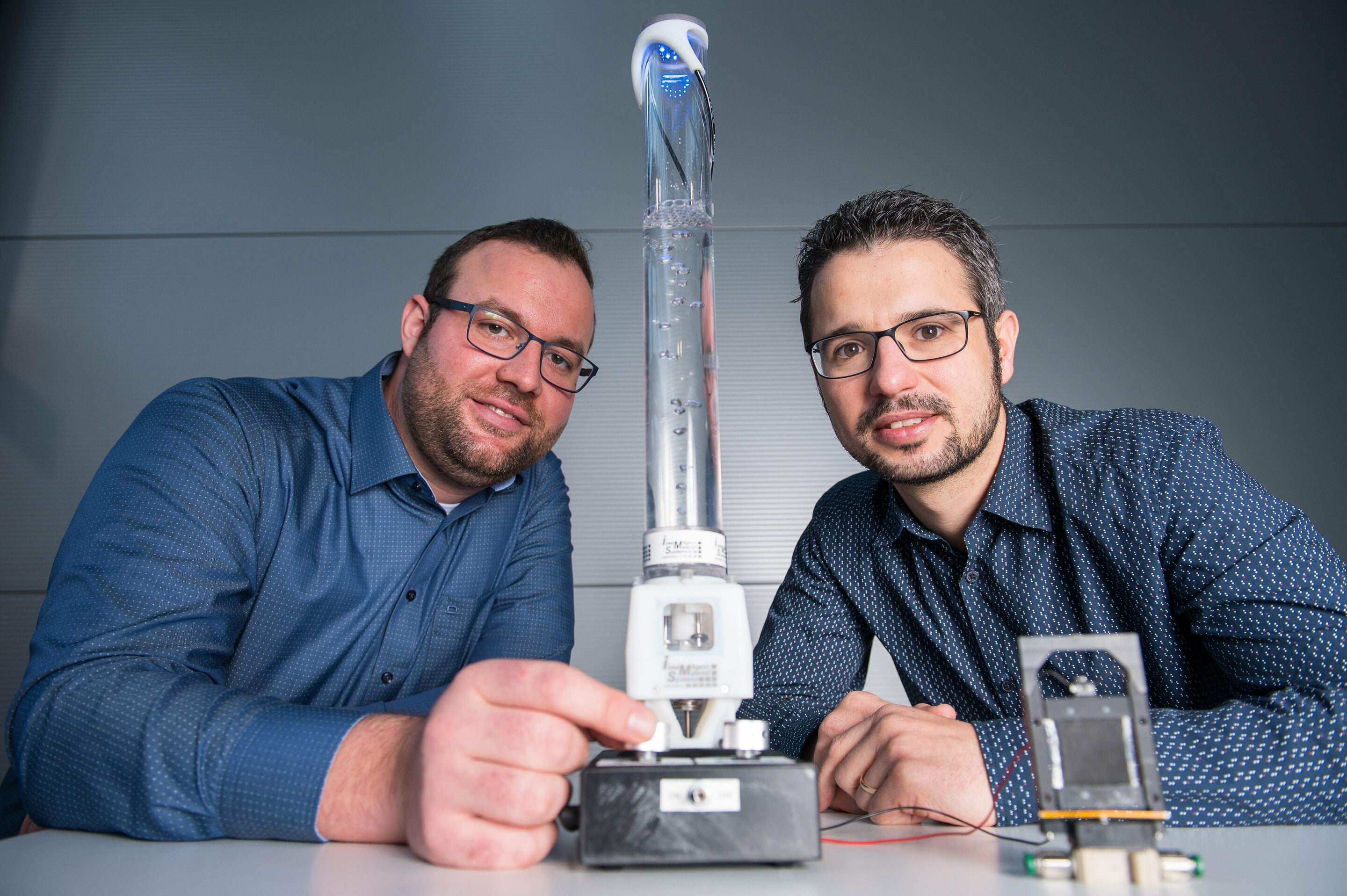 Saarland engineers with prototypes of a motorless pump (center) and a smart valve (front right) made from electroactive polymer film. Source: Oliver DietzeResearchers from Germany’s Saarland University are building pumps and valves using electroactive silicone film that enables enhanced functionalities beyond “on and off” and “open and close.”
The thin silicone film that researchers used to create the valves and pumps is printed on both sides with electrically conductive material known as dielectric elastomers. To electrically control the film to perform on-demand vibrations or pulses while simultaneously tracking its position, the researchers applied a voltage to the film. Once applied, an electrostatic attractive force was generated, which compressed the film and forced it to expand sideways.
Additionally, when researchers modified the electrostatic force in a controlled fashion, the film managed to withstand high-frequency vibrations or uninterrupted flexing motions. As such, the researchers believe that the film can assume virtually any necessary orientation or position, making it appropriate for the creation of drive systems.
The Saarland team applied algorithms to manipulate the film’s movements and used the film to construct motionless pumps and self-regulating valves.
The film enabled the design of a flat, compact, energy-efficient motorless pump by eliminating the need for separate moving components; in particular, a rotating motor. According to researchers, the pump’s volume rate is controlled through the amplitude of the voltage applied instead of frequency, which is what is commonly used.
Meanwhile, because the film can behave as a position sensor, researchers explained that the film can also be shaped into components. An electrical capacitance value can be allocated to specific locations across the film following film distortion. Once a change in capacitance is detected, operators can determine the precise amount of film that has distorted. As such, motion sequences can be precisely calculated and programmed to operate a unit and the film valve can deliver exact amounts of compressed liquid or air.
Due to the responsiveness of the material, which enables operators to vary a valve’s flow rate and to regulate a pump's performance, the film can also be used to notify operators in real time if the valves or pumps are blocked with material. Likewise, the material might signal valve or pump failures in an industrial setting, helping personnel to spot the first signs of trouble before a costly failure.