Researchers develop bipedal robot that can alter walking behaviors based on environment
Marie Donlon | March 11, 2020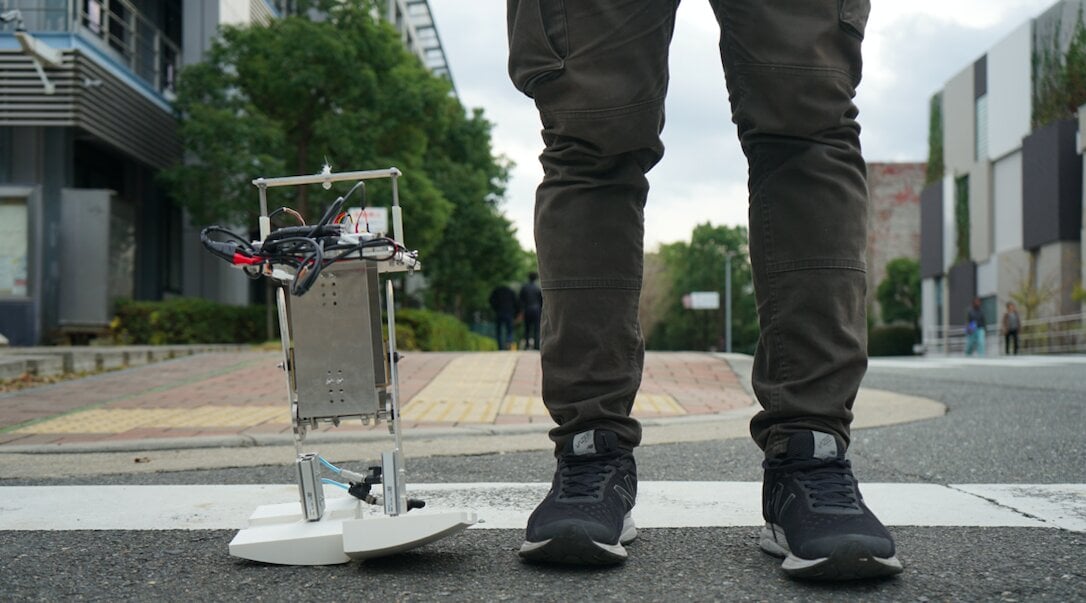 PedestriANS, the bipedal robot, crosses the street next to a human user. Source: Ahmad et al. A team of researchers from Japan’s Osaka University has developed a bipedal robot capable of adjusting its walking behavior according to changing environments.
The robot, called PedestriANS, can alter its movements to accommodate for changes in the robot’s surrounding environment, such as slowing down when a surface is slippery or changing direction to avoid potholes, puddles or other obstacles.
To modify its walking behavior, PedestriANS uses an actuator network system (ANS), which links a single motor to the robot’s legs. To adapt to changes in its environment, PedestriANS exploits the characteristics of its legs along with the interactions of the robot’s different components to achieve different walking characteristics. In other words, the robot modifies its walking behaviors by modifying the interactions between the ANS and the actuators.
The team tested PedestriANS on an assortment of material surfaces to observe how the robot shifted its morphology when introduced to the different materials. This information was then used by researchers to make alterations to PedestriANS’ design so that the robot going forward could automatically switch across individual connection patterns using its legs.
Following further development, the team intends to use PedestriANS in dynamic settings and changing environments. The Osaka University team's research appears in the journal Adaptive Behavior.
To see PedestriANS adapt to changing environments by altering its walking behaviors, watch the accompanying video that appears courtesy of Osaka University.