
A laser cleaning process for ship hulls
S. Himmelstein | March 05, 2020Biofouling on ship hulls poses a problem for operators because it increases flow resistance, fuel consumption 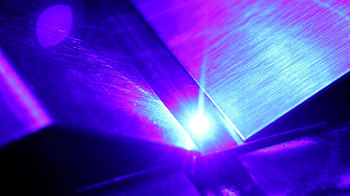 A blue laser will be tested for suitability in removing biofouling while protecting the underlying paint layer. Source: Laserline GmbHand emissions. Foundation structures of offshore wind energy, oil and gas platforms and ports are also adversely affected by biofouling. An efficient alternative to standard mechanical cleaning processes is under development in Germany.
Laser Zentrum Hannover eV, Fraunhofer Institute for Manufacturing Technology and Applied Materials Research IFAM and Laserline GmbH have partnered to develop a laser-based cleaning system. The goal is to remove the vegetation without damaging the underlying paint-based antifouling and corrosion protection coatings. The process is expected to be environmentally friendly and to be deployed underwater to facilitate full hull cleaning. Relative to current shipyard coating removal methods such as grit blast, needle guns and solvents, a laser-based system can significantly reduce waste streams and associated costs.
Field tests are currently underway at a harbor on the island of Helgoland, where Fraunhofer IFAM operates a test bench for growth tests.


My company, General Lasertronics Corporation, specializes in laser ablation of all kinds of coatings. We have spoken with shipyards about using lasers to replace media and water blast in their hull stripping operations. Consensus is that until multi-kW pulsed lasers come down quite a bit in cost, lasers are not a practical alternative. The reason is that the most expensive component of hull stripping work is the time the vessel is lost to service while the stripping takes place. This is true whether the ship is commercial or defense. While lasers work great, can be used underwater, and nearly eliminate the waste stream, they are slow for thick coatings such as hull paint or the biofouling that forms on hulls. Normally, both are removed together in drydock. Matching the current turnaround times of blasting systems would require many high powered lasers, which are currently far more expensive to buy than the equivalent blasting equipment. I wonder whether Fraunhofer IFAM and their collaborators have made some breakthrough here that enables lasers to be a practical replacement for blasting ship hulls. Obviously, stationary structures would not require the fast turnaround of ships, so lasers may work well enough there.