
Fern-inspired textile can remove oil from water
Marie Donlon | February 04, 2020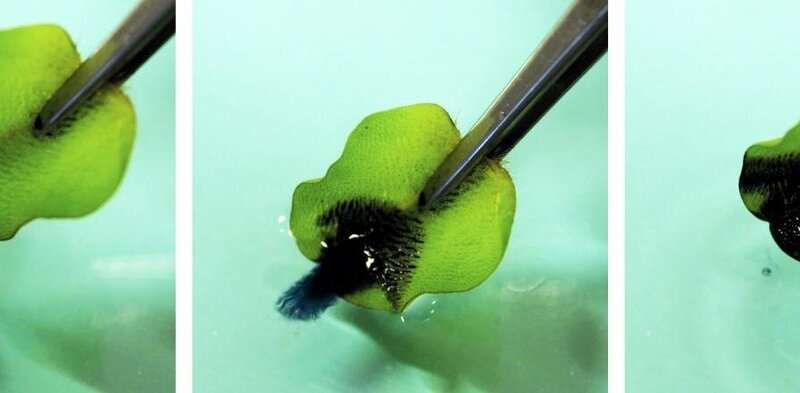 A drop of crude oil on a water surface is adsorbed within seconds by a leaf of Salvinia and pulled from the water. Source: W. Barthlott, M. Mail/Uni BonnResearchers from Germany’s Universities of Bonn and Aachen and the Heimbach-GmbH are applying the super water repellant (or super hydrophobic) properties found in a family of floating ferns to textiles designed for removing oil from bodies of water.
Inspired by the floating super hydrophobic, yet oil-loving fern Salvinia, which when submerged in water encases itself in an air pocket to keep dry, researchers have transferred those properties to a textile that can adsorb oil from the surface of water and carry it like a film to floating containers for reuse.
Because the oil is transported on the surface of the textile, it is not absorbed by the textile or mixed with chemicals to ensure that it is absorbed. Instead, the oil is clean and can be reused once it is skimmed off and deposited in a floating container, according to researchers.
However, the researchers caution that the floating fern-inspired textiles are not intended for cleaning tanker-sized oil spills. Rather, the researchers believe the technology is appropriate for use in cleaning up engine oil from cars and boats, for instance.
Details about the textile appear in the journal Philosophical Transactions of the Royal Society A: Mathematical, Physical and Engineering Sciences.


Amazing what we can discover when we study the Creator's designs!
The New Pig Corp has had oil-absorbing socks in their catalog for many years.