
Researchers develop buoyant metal inspired by spiders
Marie Donlon | November 08, 2019Researchers from the University of Rochester have developed unsinkable metal structures inspired by ants and spiders.
To develop the material, the team, led by Chunlei Guo, a professor of optics and physics at the university, subjected metal to femtosecond laser bursts - a femtosecond is equal to one quadrillionth of a second. This created a pattern that traps air, making the material water repellant, or superhydrophobic.
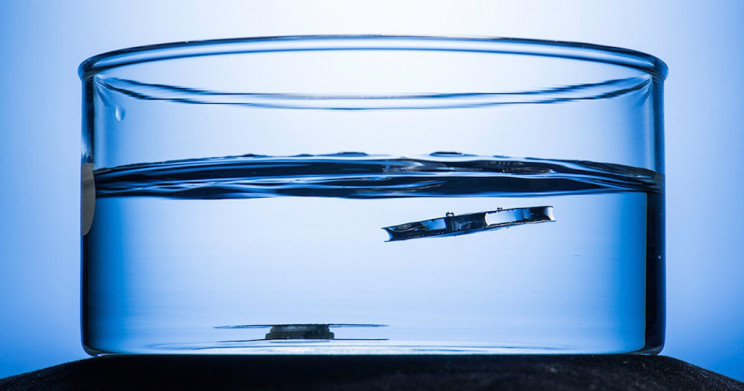 Source: J. Adam Fenster/University of RochesterAlthough the metal was buoyant for an extended period, it eventually sank. This prompted the researchers to look at spiders and ants, both of which are known to be buoyant in water for extended periods. Their buoyancy comes thanks to their ability to trap air within enclosed regions. For instance, aquatic spiders fashion underwater dome-shaped webs that fill with air brought from the surface. This structure then keeps them afloat.
Inspired by the air-filled enclosed dome, the team worked with two femtosecond laser burst-treated aluminum plates that, when placed parallel to one another, faced inward to create a structure. While the plates were close enough together to ensure that they were not exposed to wear and tear from external forces, they also were able to capture enough air and hold it between them to keep the plates afloat.
During testing, the plates were forcefully submerged and held in place for months. Researchers said that when the force keeping the plates submerged was removed, they immediately floated back to the surface. The researchers noted that this treatment would work on other metals and not just aluminum.
The team said that the process could be appropriate for uses such as a future fleet of unsinkable ships or indestructible flotation devices. Likewise, the team envisions that the process could be used to prolong the life of electronic devices that monitor the ocean.
The research appears in the ACS Applied Materials and Interfaces.


Detergent? Seems to be working based on surface tension. How does detergent effect it?