Recycling nuclear fuel with 3D-printed parts
S. Himmelstein | October 21, 2019About 95% of the actinide elements in spent nuclear fuel can be recycled, leaving only 5% to be stored as long-term waste. A process for tapping this remaining percentage and further closing the nuclear fuel cycle has been devised by Argonne National Laboratory (ANL), and demonstrated with the aid of additive manufacturing technology.
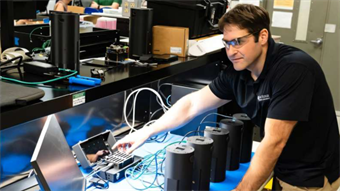
3D-printed components enable the actinide lanthanide separation process 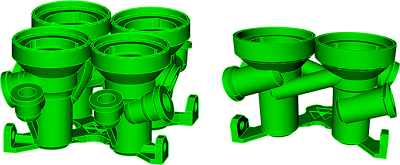 Contactor modules used for the development of the ALSEP bank. Source: A.V. Gelis et al.(ALSEP) at the laboratory scale. ALSEP separates minor actinide elements, including americium and curium, from used fuel to permit long-lived actinide isotope recycling and reduce the volume of waste that requires long-term storage. An array of 3D-printed centrifugal contactors was deployed to observe the process using small quantities of radionuclides.
The contactor housings and 1.25 cm diameter rotors were fabricated via acrylic stereolithography. Structural components were printed from carbon fiber-reinforced polyethylene terephthalate on a filament-based printer. Simulated nuclear fuel was added to one side of the row of contactors, and a chemical solution formulated to separate actinides was added to the other.
The result was 99.9% removal of the actinides from the lanthanides, and the observation that the contactors offered safeguards against nuclear proliferation. The tubes linking the contactor units run inside each device, making it more difficult to divert plutonium or other radioactive material from the process.
Transuranic actinide element recycling with the ALSEP technology could soon be realized on industrially relevant scales, according to researchers from ANL, University of Nevada and Pacific Northwest National Laboratory. The study is published in Scientific Reports.