Tackling three challenges to foster wind energy expansion
S. Himmelstein | October 16, 2019The costs of wind energy generation continue to decline as its contributions to global electricity supply steadily increases. To remain economically attractive for investors and consumers, the cost of energy from wind must continue to decrease. Overcoming three technology research challenges cited by an international group of scientists is expected to lead to new technology advancements that further minimize costs and improve power system reliability.
A deeper understanding of the spatial scale of turbulent flow and other atmospheric processes is needed as wind turbine blade tip heights and rotor sizes have increased to 200 m, with expectations for even larger sizes in the future. New measurement and modeling tools are also needed to assess the impact of the wake of one power plant on downstream plants. Improved understanding of atmospheric and wind power plant 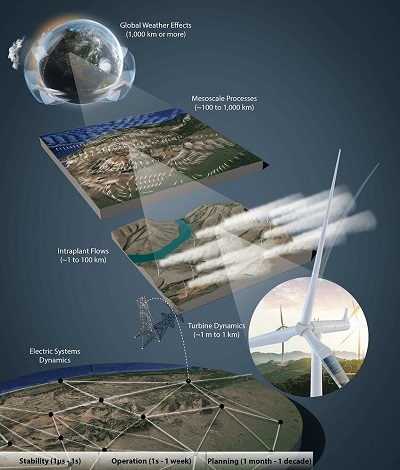 Power generated by a weather-driven plant must connect to the electrical grid and also support stability, reliability and operational needs in time scales ranging from managing disturbances at micro-seconds to planning for the next decade. Source: Josh Bauer and Besiki Kazaishvili/National Renewable Energy Laboratoryflow physics forms the first major challenge in wind energy research.
The second challenge concerns the aerodynamics, structural dynamics and offshore wind hydrodynamics of larger wind turbines. Advanced hydrodynamic models must be developed to examine configurations for offshore support structures specific to wind energy. New materials and manufacturing processes are also needed to address the emerging issues of scalability, transportation and recycling.
Wind can provide essential grid services, such as frequency control, voltage regulation and others. Three intersecting research areas comprise the third challenge, which focuses on integration of wind power plants into future electricity grids to optimize these benefits: Wind power plant controls, the converter-dominated electric grid and integrated data and modeling computational methods for system analysis and operation. Securing and transmitting real-time data on the status of a future grid will depend on the development of new sensors and data management methods.
Researchers from National Renewable Energy Laboratory, Technical University of Denmark, ForWind — Center for Wind Energy Research (Germany), Technical University of Munich, Chalmers University of Technology (Sweden), Recognis Oy (Finland), Kjeller Vindteknikk Oy (Finland), University of Colorado, University of Massachusetts Amherst, NOAA Global Systems Division, Johns Hopkins University, National Renewable Energy Center of Spain, Norwegian University of Science and Technology, University of Wyoming, Sandia National Laboratories, University of Oldenburg (Germany), Energy Systems Integration Group (Virginia), Electric Power Research Institute and Lawrence Berkeley National Laboratory contributed to this study, which is published in Science.