
US Navy tests robotic mine countermeasures
Marie Donlon | September 11, 2019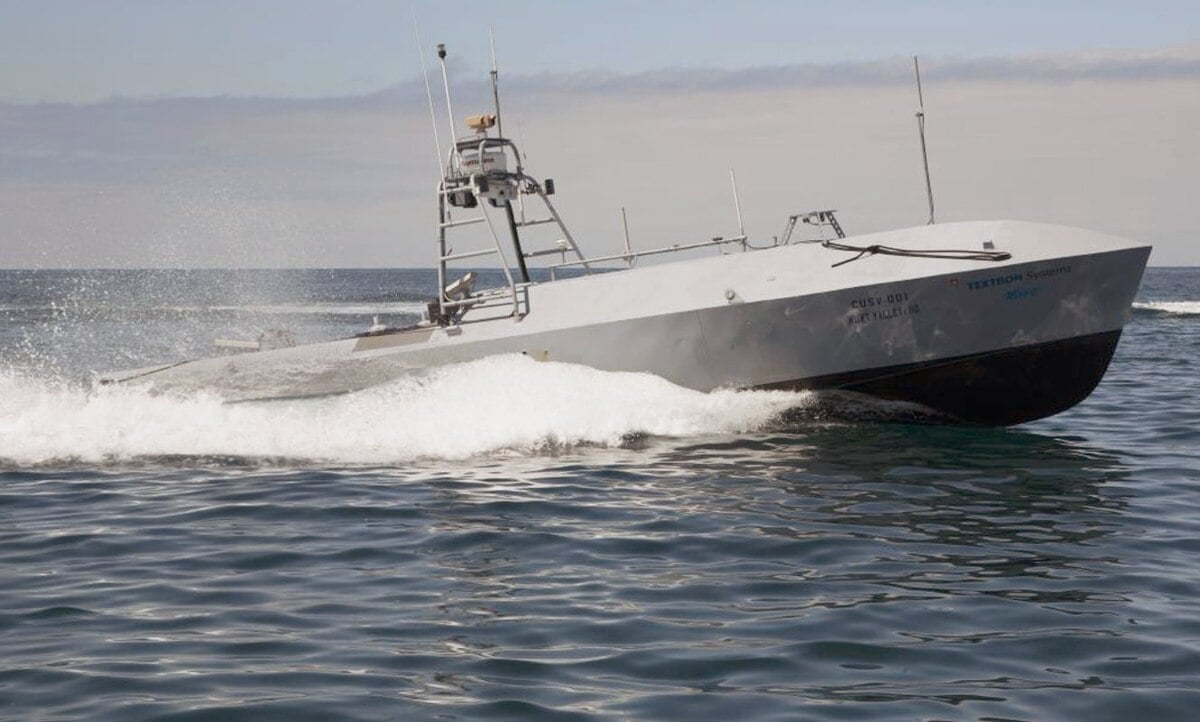 Textron's Common Unmanned Surface Vehicle works with Raytheon's sonar and mine neutralizer to autonomously find and destroy mines. Source: DoDThe United States Navy has successfully tested an autonomous, robotic system that detects, identifies and destroys sea mines.
The Mine Countermeasure Module, which has been in development for over a decade, is designed to work in concert with the Navy’s littoral combat ships (LCSs), wherein autonomous Textron common unmanned surface vehicles (CUSVs) can be launched from the LCSs.
Once the CUSV detects a suspected sea minefield, it deploys an AN/AQS-20 pod. The pod towed from the back of the CUSV and relies on sonar to locate suspected mines on the surface of the ocean, suspended from the bottom of the ocean or partially buried on the ocean floor.
Once a suspected mine has been located, the pod transmits a picture of it to human operators aboard the LCS. Once a mine is confirmed, the autonomous boat releases a Barracuda mine-killing drone into the ocean, which then releases a communications relay buoy. The Barracuda positions itself near the mine and following an order, the Barracuda will destroy the mine using an explosive charge.
It used to be that human divers, or even marine mammals, would be tasked with hunting mines. Divers would then place explosives at the mine site to destroy the mine. However, such a method proved dangerous. The Mine Countermeasure Module does not risk human lives, enabling personnel to operate the autonomous boats from afar. While the system autonomously detects mines, humans are ultimately responsible for making final decisions to explode the mines.
Another benefit of the Mine Countermeasure Module, according to the U.S. Navy, is that the autonomous mine-hunter is considerably faster than human countermeasures. Multiple mines can be destroyed by the CUSV during a single mission, whereas with humans the process might take several missions over the course of weeks. Likewise, the human process requires a number of human players, whereas the automated method requires only the robotic boats.


Or they could deploy an AN/AQS-24 towed sonar system from the CUSV.
https://www.navy.mil
https://insidedefens
https://navy-matters
Here is what the Q-24 looks like being deployed from an ARCIMS surface vessel. ARCIMS is similar to the CUSV. In the next few weeks, the Q-24 will be field tested aboard a CUSV at the Navy ranges off of Panama City, FL.
https://www.scoop.it