Team bioprints complex tissue in mere seconds
Marie Donlon | August 26, 2019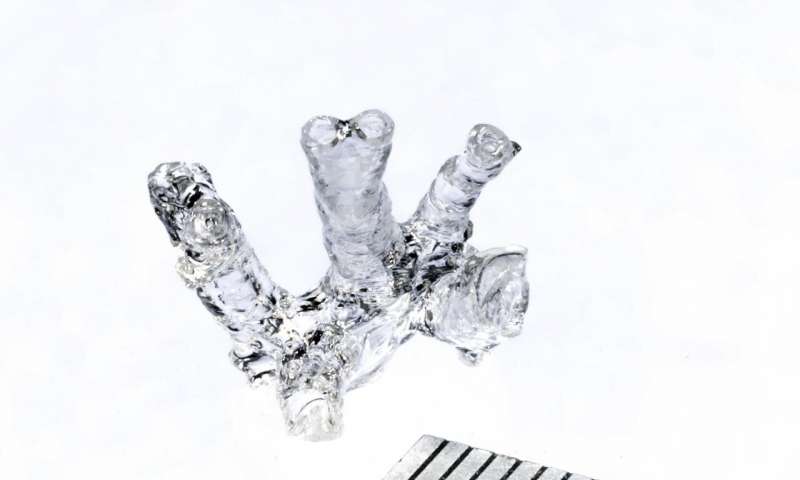 The hollow mouse pulmonary artery model. Source: Alain Herzog/2019 EPFLScientists from École Polytechnique Fédérale de Lausanne (EPFL) and University Medical Center Ultrecht in the Netherlands have developed an optical system capable of bioprinting complex and viable living tissue in a matter of seconds.
Showing promise for potentially repairing injuries, replacing entire organs and for testing drugs in vitro, the approach, dubbed volumetric bioprinting, creates tissue by projecting a laser into a spinning tube that contains hydrogel mixed with stem cells. The tissue that results from this combination can be shaped by focusing the laser’s energy on particular points, causing the tissue to solidify and develop into 3D shapes within a matter of seconds. Once achieved, researchers introduce endothelial cells, which add vessels to the tissue.
Although just a few inches wide, the resulting tissue is reportedly “clinically useful” and has so far been used to print a meniscus, a complex femur part and heart-like valves. Additionally, the tissue can also create interlocking structures.
"Unlike conventional bioprinting — a slow, layer-by-layer process — our technique is fast and offers greater design freedom without jeopardizing the cells' viability," said Damien Loterie, a co-author of the study and researcher in the Laboratory of Applied Photonics Devices (LAPD) in EPFL's School of Engineering.
While not currently ready for real-world applications, EPFL researchers envision “personalized functional” organs manufactured at "unprecedented speed.” Likewise, such a method could potentially be used for implants and repairs. The process could also potentially eliminate the need to conduct animal testing, where instead of testing a new drug on animals, researchers could print an organ to simulate effects.
"This is just the beginning. We believe that our method is inherently scalable towards mass fabrication and could be used to produce a wide range of cellular tissue models, not to mention medical devices and personalized implants," said Christophe Moser, the head of the LAPD.
The research is published in the journal Advanced Materials.