
Scientists are making a plastic alternative from lignocellulose
Marie Donlon | August 20, 2019 System for selective photocatalytic valorization of cellulosic biomass. Source: IPC PAS, Grzegorz Krzyzewski
To develop an alternative to single-use plastic packaging and other plastic waste, a team of scientists from the Physical Chemistry of the Polish Academy of Sciences (IPC PAS) is turning waste into a fully biodegradable plastic alternative.
The team of scientists is turning hydroxymethylfurfural (HMF), which is a common product that is sourced from the acid hydrolysis of sugars obtained from cellulose, lignin or inulin among others, into aldehyde, 2,5-diformylfurfural (DFF), a compound with applications in countless industries that is used to produce cosmetics, fragrances, fuels, medicines and chemical agents to name just a few products. Reportedly, it can also be used to develop environmentally friendly plastic.
“We want it to be possible to replace PETs with something that decomposes in a few months or at most a few years," explained study lead Professor Juan Colmenares. "Today's plastics, made from petroleum, contain phthalates and other plasticizers — a sort of "soup" of organic and even inorganic compounds — and no bacteria or fungus on their own can break them down. That's why they remain for so long in the forests and seas. Materials produced based on DFF contain furans — sugars, and what comes from nature is better received by nature," the professor continued. "There have already been tests of such polymers. They break down into monomers resembling sugars. And sugars are a tasty treat for many microorganisms. Even if a bottle of this sort of plastic is thrown away into the forest, it will decompose much faster than conventional polymers, after a few years at the latest."
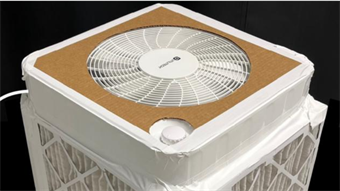
Although DFF itself is nothing new, the method for acquiring it as devised by the IPC PAS team reportedly is. Previously, high temperatures (100° C to 150° C) and sophisticated technology had been necessary for acquiring DFF, which meant that it could not compete with petroleum-based products. Yet, the team devised a method for acquiring DFF that requires just a box that they produce, which is composed of a photoreactor (currently an LED lamp that emits near UV 375 nm) and manganese dioxide nanowires acting as a catalyst.
The structure of the nanowires, which are long and extremely thin, increase light absorption. Likewise, the unique thermo-photo-catalytic properties of manganese dioxide enable the nanowires to have significantly larger contact surface with the particles of the starting material, which better activate it. As such, most, if not all of the HMF transforms into DFF.
According to researchers, the method is a waste-free one without adding oxygen or extra compounds (for instance hydrogen peroxide H2O2). The oxygen present in the air is sufficient enough to acquire the pure monomer necessary to generate linear polymers.
Additionally, the researchers explain that the nanowires can be reused as photocatalysts as the DFF does not destroy them. Similarly, it does not release manganese 2+ and 4+ ions and, consequently, does not need to be purified.
The conditions necessary for the process are room temperature and atmospheric pressure, Colmenares explained. Simultaneously, an inexpensive and common material is used (as manganese oxide is neither silver, platinum nor gold), thereby making the method simple. They merely precipitate and selecting the appropriate conditions is all that is necessary for an efficient process.
When describing the invention, Professor Colmenares explained, "At present we are restricted by the capacity of the reactor, but when we change it to a flow reactor, we will be able to increase production greatly. And, of course, obtain a patent."
The research appears in the journal Applied Catalysis B: Environmental
Well it at least self destructs so no one has to pick it up. I was hoping more for a deposit like I remember from my childhood days. If the person paying did not wish to devote the time and effort to returning the bottle, at least someone would pick it up and collect the deposit.