Getting the lead out of solar cells
S. Himmelstein | August 01, 2019Lead-halide perovskite solar cells are prized for their relatively high-power conversion efficiencies, but these are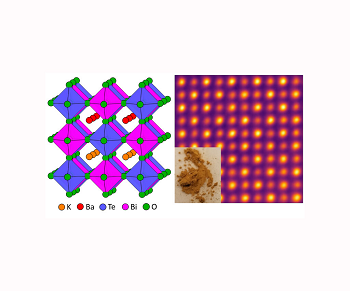 An atomic model of perovskite semiconductor (left), and a scanning transmission electron micrograph inset with a photo of the synthesized powder (right). Source: Rohan Mishra undermined by instability and lead toxicity issues. A semiconductor material that ticks all the desired photovoltaic and environmental performance boxes was identified by researchers from Washington University in St. Louis.
Researchers investigated 30,000 potential bismuth-based oxides by applying data analytics and high throughput density functional theory calculations. The most promising and stable double perovskite oxide compound is composed of potassium, barium, tellurium, bismuth and oxygen, and was determined to have an experimental indirect band gap of 1.88 electron volts (eV).
The researchers plan to advance material synthesis routes, examine the role of defects on semiconductor performance and lower the band gap to 1.5 eV.