
Solar Cells Get the Lead Out
S. Himmelstein | July 25, 2017The advent of perovskite solar cells has reduced the cost of cell manufacturing while yielding devices as efficient as their silicon-based counterparts. Hybrid lead halide perovskites don’t require the high purity levels essential for silicon, thereby reducing the energy-intensiveness of production. However, the use of lead as a solar cell constituent is of concern to some, prompting materials researchers to seek non-toxic but high-performing replacements.
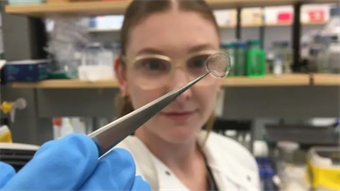
Researchers from the United Kingdom and the United States have shown that bismuth could be a non-toxic alternative to lead for use  Researchers demonstrated how a non-toxic alternative to lead could form the basis of next-generation solar cells. Image credit: University of Cambridgein next-generation solar cells. Theoretical and experimental methods were used to weigh the potential use of bismuth oxyiodide, which has been previously considered for use in solar cells and water splitting but was not deemed suitable due to low efficiencies and degradation in liquid electrolytes.
The compound was demonstrated to be as tolerant to defects as lead halide perovskites, as well as stable in air for at least 197 days. A device composed of a bismuth oxyiodide light absorber layered between two oxide electrodes converted 80 percent of light to electrical charge – a record performance.
Bismuth-based cells can be made using common industrial techniques, indicating that they can be produced at scale and at low cost. A theoretical limit of 22 percent efficiency, comparable to silicon and the best perovskite solar cells, was calculated.
Scientists from the University of Cambridge (U.K.), MIT, the National Renewable Energy Laboratory and Colorado School of Mines participated in this research.
Apparently contradictory statements about the efficiency of stated bismuth oxyiodide (perovskite analogue) solar cells, now is it 80% conversion of light to charge, or is it 22% theoretical value, and the 80% is of the 22% that is the maximum possible?
Please learn to write in plain English.
In reply to #1
Did you read the original study? Please learn to comprehend English.
In reply to #2
No, I only had time for the blurb Mr. anonymous, and the blurb did not say quantum efficiency. It just said 88%.
In reply to #2
To be fair, the paper doesn't really say the same thing as is claimed here. The paper says up to 80% quantum efficiency for monochromatic illumination, while this blurb claims 80% of the light converted to electricity.
In reply to #4
Thank you! It is hell to argue with a Dutchman, most times.