
Underwater restaurant in Norway doubles as a laboratory
Marie Donlon | May 06, 2019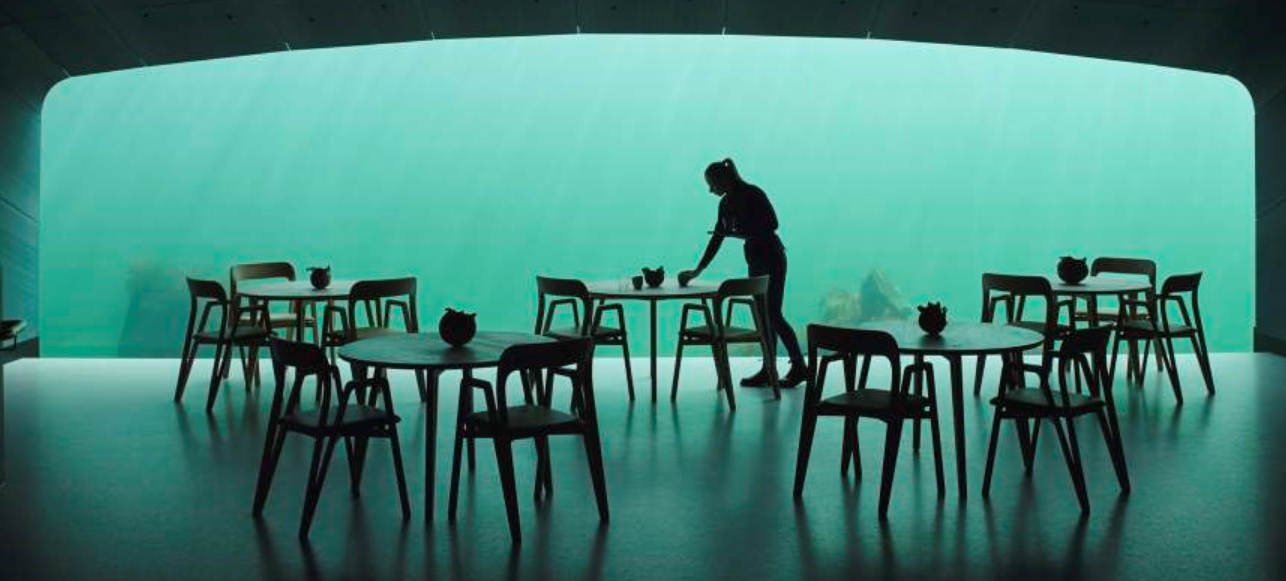 Source: Snøhetta
An underwater restaurant in Norway doubles as a marine life laboratory and research facility.
The recently opened restaurant, aptly named Under, is a partially submerged concrete structure located in Lindesnes, a town in the southern tip of Norway. It serves diners local and sustainable fare, including bycatch, along with an underwater view from roughly 16 feet below the surface of the ocean. An enormous wall of glass is all that separates diners from the ocean depths and creatures, such as cod, crabs, dogfish, lobsters and seals.
In addition to being a restaurant, the structure is also partly funded by the Norwegian government as a laboratory. Students from nearby Agder University conduct research into the ocean ecosystem from the site. Designed by Norwegian architecture firm Snøhetta, which was also responsible for the design of the National September 11 Memorial and Museum in New York, the restaurant's outer walls were built to act as an artificial reef and is home to limpets, seaweed, sea snails and barnacles. The structure was also designed to withstand the characteristically rough waters off of Lindesnes.
For diners who cannot make the trek to Norway or who do not have patience enough to wait on the roughly six-month-long waiting list to dine at the restaurant, a livestream of the underwater restaurant views will soon be set up by researchers with an eye toward inviting viewers to participate in a citizen science project. Viewers may one day be tasked with capturing their own images of any unusual species they see while watching the livestream. Those images would eventually be compiled and then used for machine learning to train the camera to independently recognize new or unusual species.
“The biodiversity of cold waters is not well known. We think the more people gain knowledge of marine life, the more they will look after our oceans,” explained Trond Rafoss, an associate professor at Agder University and Under’s in-house marine biologist. “We call the whole thing an eye into the coastal ecosystem.”

Cool, study underwater creatures and find out how they taste!
It will be nice if there's no trash in the water. I think that would be the biggest challenge to underwater restaurant projects in many coastal areas... to keep the view perfectly "appetizing".