Smart Sensor System for multiple autonomous vehicle applications announced
Engineering360 News Desk | April 22, 2019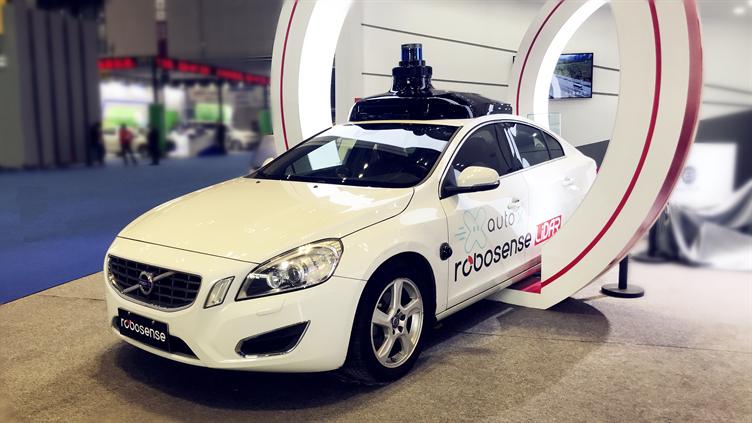 Applications for the new Smart Sensor System include RoboTaxis, Source: RoboSense
At the Shanghai Auto Show running April 16-25, 2019, in Shanghai, China, lidar solutions provider RoboSense announced the launch of its Smart Sensor System (SSS). The company has teamed up with partners Horizon Robotics, Cainiao Network, Sensible 4 and AutoX to deploy the system into autonomous passenger cars, low-speed autonomous vehicles, high-speed RoboTaxis and vehicle to road (V2R) infrastructure. The SSS combines new light detection and ranging (lidar) hardware, AI point cloud algorithms and an IC design to produce a strategy that collects and interprets environment information.
RoboSense debuted its early-version RS-Lidar-M1 sensor at CES 2018; an upgraded version won awards at CES 2019 for its wide 120° FOV, long 200 m range and AI algorithm innovations. The newest version, which is mass production-ready, meets OEM requirements and delivers safety for L3+ autonomous passenger cars. According to the company, the sensor will provide instantaneous 3D point cloud data interpretation and output target level environment perception results in real-time. RoboSense and Horizon Robotics have reached an initial intention of cooperation to build customized chips for the RS-lidar-algorithms that enable environment perception; mass production is slated for 2021.
Two new lidar products also integral to the SSS are the RS-Bpearl, a super wide-angle blind-spot lidar; and the RS-Ruby, a super high-resolution lidar.
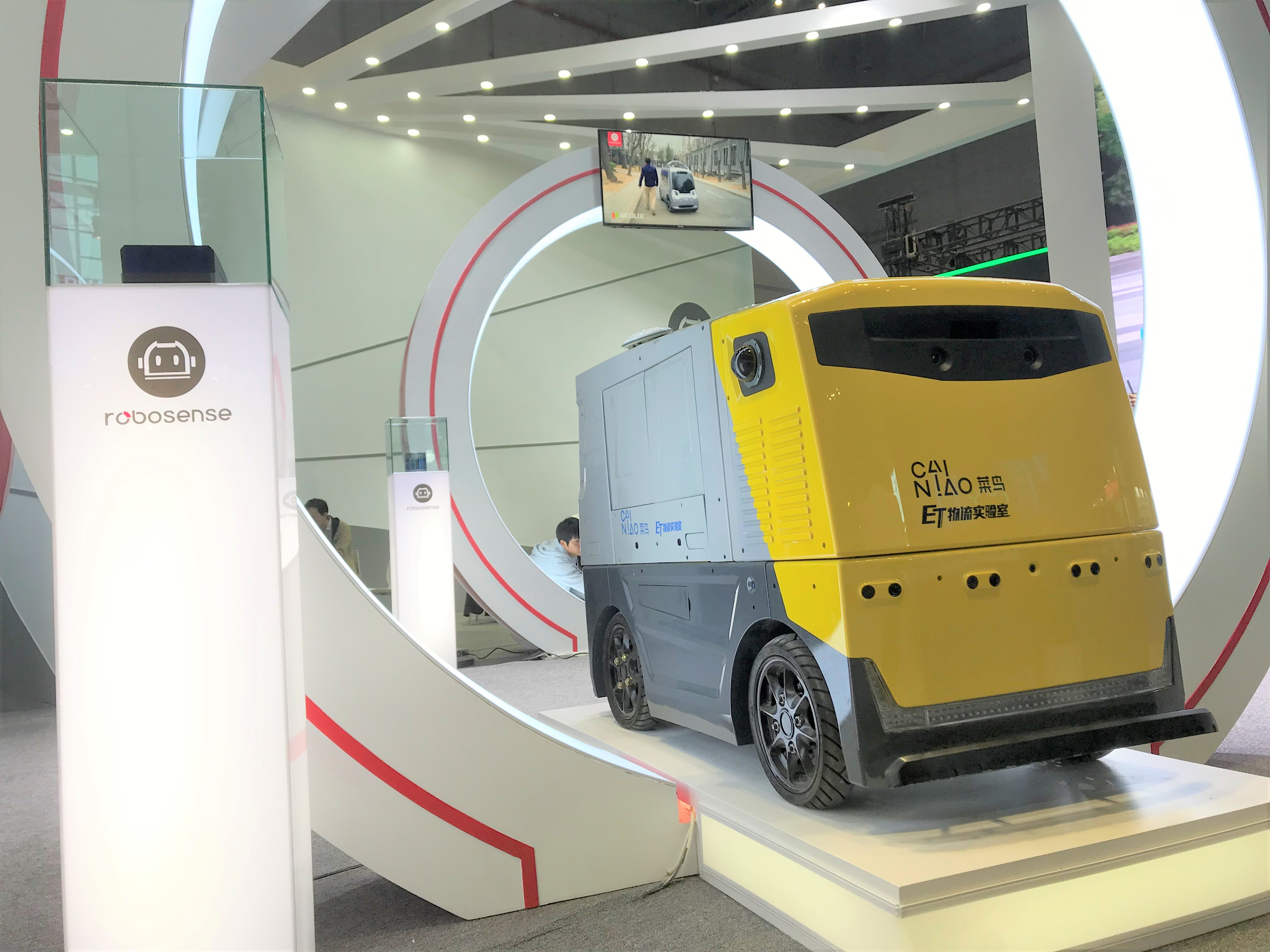 Unmanned low-speed vehicle developed by RoboSense and Cainiao. Source: RoboSenseThe RS-Bpearl, developed with Alibaba’s Cainiao Network, is designed to solve a major stumbling block for unmanned low-speed vehicles: blind spots caused by the limitations of vertical field of view (FOV). Thanks to their wide deployment in applications such as inspections, security, cleaning and delivery, such vehicles are sometimes considered the pioneers of autonomous driving. The new device offers FOV of 360° × 90°, within the detection range of 30 m (10%) for a tiny 10 cm blind spot. The compact size of the sensor also enables application to the side of the vehicle body, while its modular design reduces cost and adds the possibility of flexible customization.
The RS-Ruby offers three times higher 0.1° resolution and three times longer detection range as compared with the previous version RS-Lidar-32. As demoed by RoboSense and AutoX, deployment for RoboTaxis consists of one RS-Ruby lidar as the core sensor on top of the vehicle to cover the 360° overall perception, and two RS-Bpearl lidars on the sides of the car’s hood to detect blind spots.
In addition, RoboSense’s road-side perception V2R systems allow vehicles to work with road conditions to coordinate and optimize the vehicle’s driving path; used in conjunction with lidar sensors and perception algorithms, the systems deliver autonomous vehicles with a birds-eye view of the road and traffic and enable them to deal with challenging road conditions.
Finally, RoboSense’s partnership with Sensible 4 produced what it says is the world’s first autonomous driving shuttle bus for all weather conditions, the GACHA. The vehicle is equipped with an advanced cold-resistant 16-beam mechanical lidar environment perception system that works on snow- and ice-covered roads, and operates in temperatures as low as -22°F (-30° C).