New polymers provide protection from fuel explosions and fires
S. Himmelstein | April 03, 2019The devastation wrought by two fuel-filled jumbo jets striking New York City’s World Trade Center on September 11, 2001, might have been mitigated with a polymer-based prescription advanced by California Institute of Technology researchers. The addition of ultralong polymers to aviation fuel would have lessened the destructive force associated with fuel misting and the subsequent conflagration.
The pursuit of polymeric materials that could dissipate the fuel misting-linked impact energy of accidents and 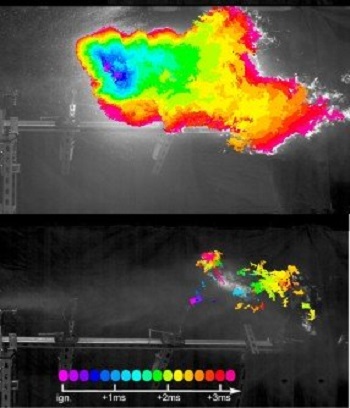 New polymer fuel additives are better at reducing explosive fires (bottom) than conventional additives (top). Source: Julia Kornfield, California Institute of Technologyother events resulted in the development of polymers that reversibly link up end-to-end via carboxylic acid and amine groups to form megasupramolecules. Unlike existing ultralong polymers, the new material doesn’t degrade engine performance or lose efficiency by breaking down into smaller molecules when transmitted through pumps or pipelines. When added to fuel, these high-performance polymers can mitigate impact-induced damage even when it is not possible to retrofit existing equipment or structures.
Tests demonstrated reductions in fuel misting, as well as the ability of a flame to self-extinguish after fuel ignition. The material was also observed to remain active after passing through more than 600 miles of pipeline and hundreds of pumps, proving the megasupramolecules to be far more durable and effective than ultralong polymers, which typically underperform after 50 miles.
The high-performance polymers also remain soluble at low temperatures — down to the freezing point of kerosene — and reduce diesel engine soot formation by 12%.
The research was presented at the American Chemical Society Spring 2019 National Meeting & Exposition.