Watch how smart pajamas can benefit sleep patterns
S. Himmelstein | April 01, 2019Smart apparel with embedded self-powered sensors can advance human health monitoring by leveraging clothing as the sensing substrate. Now sleepwear fashioned by University of Massachusetts engineers inconspicuously integrates sensing elements and portable power sources to track heartbeat, breathing and other parameters as the user slumbers.
Reactive vapor coating technology transforms readily available textiles or garments into wearable electronic devices by directly coating them with uniform and conformal films of electronically active conjugated polymers.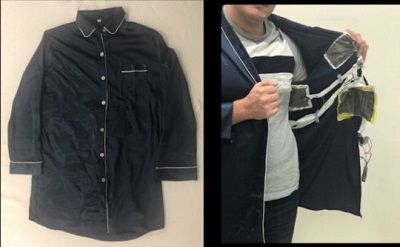 Ordinary-looking pajamas are transformed into smart ones with five strategically placed sensors that measure heartbeat, respiration and posture. Source: Trisha L. Andrew/University of Massachusetts The synthesized electronic components include resistors, transistors, diodes and thermistors. The vapor-deposited electronic polymer films are wash-and-wear stable and withstand mechanically demanding textile manufacturing routines, enabling application of sewing, weaving, knitting or embroidery procedures to create self-powered garment sensors.
Five discrete sensor-equipped textile patches in the pajamas – or Phyjamas – are interconnected with silver-plated nylon threads shielded in cotton. Four piezoelectric patches track body pressure against the bed and the sleeper’s posture, and a triboelectric patch provides information on heart rate. Wires from each patch lead to a button-sized printed circuit board collocated with a pajama button. Data are wirelessly sent to a receiver using a small Bluetooth transmitter that is part of the circuitry in the button.
The researchers presented their Phyjama system at the American Chemical Society Spring 2019 National Meeting & Exposition, and plan to extend the technology to wearable electronic sensors that detect gait and send feedback to a monitor to help prevent falls.