Study: Coating tested on ISS to battle bacteria in space
S. Himmelstein | March 20, 2019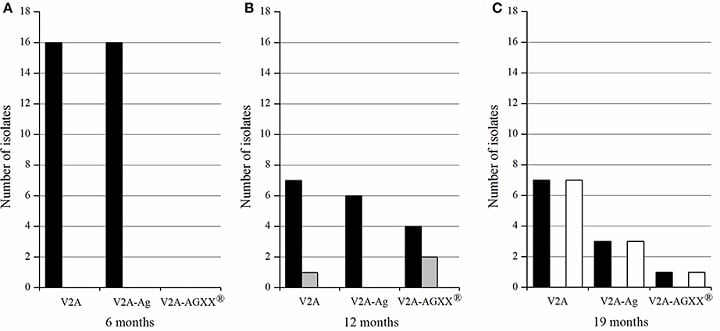 Number of Gram-positive pathogenic bacteria recovered from the different materials: bare steel (V2A), conventional coating on steel (V2A-Ag) and AGXX on steel (V2A-AGXX) after 6 months (A), 12 months (B), and 19 months (C) exposure on the ISS. In black, Staphylococcus spp.; gray, E. faecalis; white, B. cereus. Source: L. Sobisch et al.
The hostile environment encountered on space missions can leave travelers susceptible to infection while being kind to astronaut-borne bacteria. The forces imposed by microgravity and cosmic radiation help cause otherwise harmless microbes to adapt in ways that threaten the human immune system. The potential for a new antimicrobial coating to protect crews from potentially pathogenic passengers was tested on board the International Space Station (ISS).
The performance of a conventional silver coating was compared with that of AGXX, a new silver- and ruthenium-based coating for six to 19 months on the ISS. Stainless steel sheets affixed to the bathroom door served as the substrate for testing the materials.
No bacteria were detected on the AGXX surface after six months, and only nine colonies were detected after 12 months and three after 19 months for an 80% reduction compared to bare steel. The conventional silver coating exerted a slight antimicrobial effect, reducing the number of bacteria by 30% versus steel.
The bacteria isolated from all materials were predominantly staphylococci and bacilli. While no serious human pathogens were detected on any surface, many of the types identified were found to be resistant to at least three antibiotics and were able to share the genes responsible for antibiotic resistance.
Scientists from Beuth University of Applied Sciences and University Freiburg in Germany, and Russia’s Institute of Biomedical Problems conducted the research, which is published in Frontiers in Microbiology.