Watch: Smart house for a smart mouse; team creates smart home to study mice behavior
Siobhan Treacy | March 11, 2019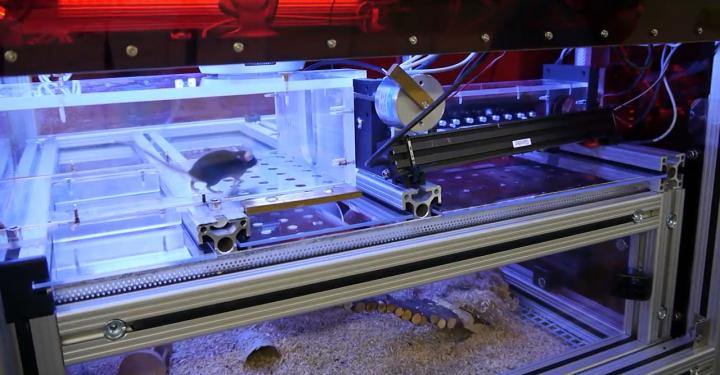 Autonomouse, the smart house for mice. Source: Andrew Erskine
Researchers from the Francis Crick Institute have created a smart house for a mouse. More specifically, a family of mice. The house, called Autonomouse, was created to help the researchers study how the mice react to living in a smart home.
When researchers want to study human behavior, first they turn to mice. Mice are often used as a stepping stone toward a larger study on humans. In this study, the researchers wanted to see how the mice would behave after living, undisturbed, in a smart house for an extended period of time.
Autonomouse has running wheels, ladders and unlimited access to food and water. A group of mice will live in Autonomouse for 18 months with minimal interaction with the outside world.
Each mouse is microchipped. The microchip allows the researchers to track the mouse’s activity levels, weight, activity and water consumption while maintaining minimal interaction with the mice. The microchip also acts as an ID pass, letting the mice into the training rooms in the house. Once a mouse enters a training room, a door shuts behind it, separating it from the rest of the mice until it completes the training task. The training data is automatically recorded, linked to the mouse’s ID number and sent to the researchers.
"Working with an unstressed, group-housed cohort of mice that train themselves at the time of day that suits them, without the intervention of researchers over long periods of time, makes our experiments better and more efficient," said Andreas Schaefer, Group Leader at the Crick who led the project.
The researchers have made the design and software of the system available for other research teams to use. A paper on this technology was published in PLOS ONE.