
Campus housing project aims to be net-zero energy efficient
David Wagman | February 26, 2019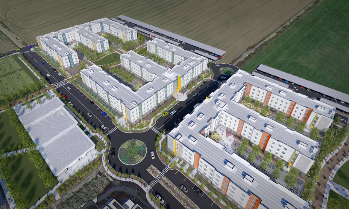 Artist's concept of new $575 million housing project at UC Davis. Source: UC Davis
The University of California, Davis, began work in late February on a $575 million project to add nearly 3,300 beds to the university’s West Village neighborhood.
The first 1,000 beds are expected to be delivered by the start of the fall 2020 academic year. The project ranks as one of the largest student housing developments in the U.S.
The Michaels Organization is developing the project. The full $575 million in project costs will come from the proceeds of a tax-exempt bond sale, one of the largest ever for a student housing project. Design, architecture and engineering firm Stantec is providing lead architectural, interiors, buildings engineering and landscape design services. CBG Building Company is the general contractor.
The new housing has a goal of reaching 100% net-zero energy efficiency on an annual basis, which means the project would to generate as much energy as it uses within a year. The project will be set on 34 acres and will include nine four-story apartment buildings, along with indoor and outdoor community space and recreational fields.
A 10,000 ft2 community building will house a fitness center, multipurpose room and student support services. Original plans called for 1,875 beds, but the university reduced space set aside for student parking, allowing for more residential units.
The development project was approved by the UC Regents in July 2018 and is part of UC Davis’ Long Range Development Plan, which projects adding 9,050 beds of on-campus housing.
The development will be built through a public-private partnership between UC Davis, Collegiate Housing Foundation (a 501c3 nonprofit) and University Student Living of New Jersey. When construction is complete, the apartment complex will be operated by Collegiate Housing Foundation, which will hold the ground lease from the University of California. UC Davis Student Housing and Dining Services will provide on-site program and residence support services and be responsible for leasing and marketing activities.
The first phases of apartments at West Village opened from 2011 to 2013. Prior to the start of the new construction, the existing complex had capacity for 2,261 students.
Tight housing market
The university released a market survey in early February that reported a blended vacancy rate — including apartments leased by the unit and by the bed — of around 0.5% in Davis. That compared with a 0.3% vacancy rate in the fall of 2017. Rents rose year-over-year by an average of 6.5%.
The average monthly rent for unit-leased apartments of all sizes was up 8.5%, from $1,673 in 2017 to $1,815 in 2018. The average monthly rental rate for a bed lease was up 6.9%, from $892 in fall 2017 to $954, the survey reported.
The university guarantees housing to freshman and transfer students. Its Long Range Development Plan starts with a baseline of 9,818 beds in 2016-2017 and projects building to at least 15,000 beds by the fall of 2023.
Among projects that will add campus housing:
- In fall 2019, the new Yosemite Hall is scheduled to reopen with 400 beds.
- Also in fall 2019, the scheduled opening of a new dining commons to allow for future growth and greater flexibility.
- The Emerson Hall project is scheduled to begin in the summer of 2019 with the goal of opening a year early in fall 2021, with 800 residence hall beds for new freshman students.
- The campus is working on the planning, design and financing for the Orchard Park redevelopment project to house students with families and graduate students.




Saving money no matter what it costs.
Great!