Engineers show the heart can replace batteries in medical implants
Amy J. Born | February 08, 2019Engineers from Dartmouth College have developed a way to eliminate batteries as the power source for implantable medical devices such as pacemakers and defibrillators. The new power source is none other than the heart itself. The team from Dartmouth’s Thayer School of Engineering is testing two devices (pictured below) that convert the heart’s kinetic energy into electricity.
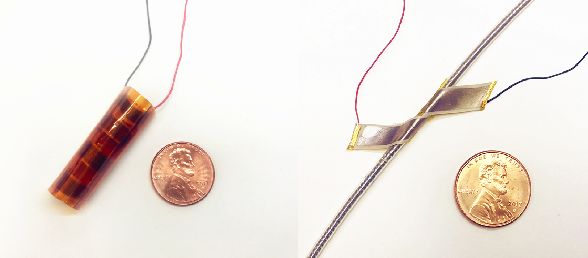 Buckled beam array (left) and cantilever energy harvester are the two devices being tested to eliminate pacemaker batteries. Source: Dartmouth CollegeThe batteries currently used to power life-saving devices in millions of people need to be replaced as often as every five to 10 years. This requires surgery with all the inherent risks and complications, as well as the expense and downtime for the patient. The goal of this research, according to John X.J. Zhang, engineering professor and a lead researcher on the study, is to avoid those additional surgeries with an effective energy source that will allow the implanted device to work for the patient’s entire lifespan.
“Of equal importance is that the device not interfere with the body’s function,” adds Dartmouth research associate Lin Dong, first author on the paper. “We knew it had to be biocompatible, lightweight, flexible, and low profile, so it not only fits into the current pacemaker structure but is also scalable for future multi-functionality.”
The team successfully modified the pacemaker, in animal studies, by adding a thin polymer piezoelectric film, called PVDF, designed with porous structures that converted the mechanical motion of the heart into electricity. Potentially, these modules could also be used as sensors for data collection and real-time monitoring of patients.
According to an article on the University of Iowa Hospitals and Clinics website, when batteries are replaced in pacemakers and defibrillators the entire device is upgraded with the latest technology. This may seem like an advantage to battery replacement, however, engineering professor Zi Chen, an expert on thin structure mechanics, explains that the potential hazards of the batteries as well as the risk of additional surgeries likely override any benefits of upgraded equipment.
"As is seen from the incident caused by the Samsung Note 7 battery faults, the risks associated with the failure of implanted batteries could be fatal. The potential hazards related to batteries include unexpected release of heat or electrolyte leakage resulting in toxicity to tissues. For implantable medical devices, the risks can be easily magnified due to the fact that the devices will be inside the human body for important functions where any failure could make a difference between life and death,” he said. “With the development of technologies it is feasible that the implantable biomedical devices can last a really long time so while there are benefits associated with getting an updated device all the pros and cons will have to be taken into account when making a decision like that. In any case, having the system updated will remain an option regardless."
 Lin Dong, Dartmouth research associate. Source: Dartmouth College
According to Zhang, a self-charging pacemaker is approximately five years out from commercialization. “There is already a lot of expressed interest from the major medical technology companies, and Andrew Closson, one of the study’s authors working with Lin Dong, is learning the business and technology transfer skills to be a cohort in moving forward with the entrepreneurial phase of this effort.”
Also involved in the study were clinicians at UT Health San Antonio, including Dr. Marc Feldman, professor and clinical cardiologist.
The results of the three-year study, completed by Dartmouth’s engineering researchers along with clinicians at UT Health San Antonio, were just published in the cover story for Advanced Materials Technologies.