Natural Gas Pipelines: A Vital Web Shows Its Vulnerabilities
Shawn Martin | June 11, 2015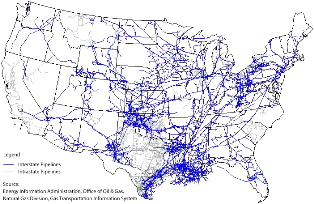 Map of both interstate and intrastate natural gas pipelines in the United States. Image source: EIA.
Problems facing current midstream infrastructures—specifically natural gas pipelines—are twofold and include a need for potentially a substantial investment and overhaul. Outdated leak-prone pipelines have brought on increasing safety concerns with densely populated areas near some of the oldest pipelines that are in need of repair. Infrastructure investments are also needed to support gas-fired electric power generating stations as the energy sector has grown increasingly dependent on natural gas to meet energy demands.
Safety concerns are highlighted by incidents such as the gas pipeline explosion on Jan. 14, 2015. The explosion near the Ross Barnett Reservoir in Brandon, Miss., caused no injuries but left a sizeable crater in the ground and burned 6 acres of vegetation. The explosion emanated from a repaired sleeve over pipe that was manufactured in 1952.
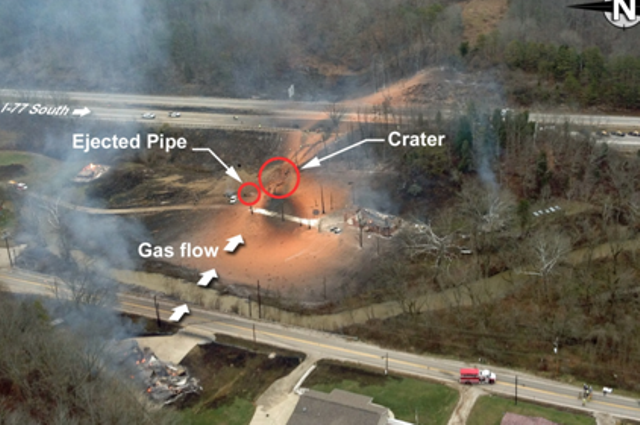 A 2012 explosion threw a 20-foot-long pipeline segment more than 40 feet. Image source: ISHN.com On Dec. 11, 2012, a 20-inch high-pressure natural gas pipeline running through Sissonville, W.V., ruptured with so much force that a 20-foot-long segment of pipe was thrown more than 40 feet from where it had been buried. The released natural gas ignited and burned so hot that it heavily damaged the asphalt road surface on an interstate highway, destroyed three homes and melted the siding on houses hundreds of feet from the rupture site.
In september 2010, a natural gas pipeline owned by Pacific Gas & Electric (PG&E ) exploded in San Bruno, Calif., killing eight people and destroying 38 homes. In response, PG&E unveiled a plan in August 2011 to modernize and enhance safety of its gas transmission operations over several years, including automating more than 200 valves, strength-testing more than 700 miles of pipe, replacing another 185 miles and upgrading some 200 miles to allow in-line inspection.
Pipeline Vulnerabilities
Much of the U.S. gas transmission and gathering pipeline infrastructure is outdated or undersized and in need of replacement and/or overhaul. The “Quadrennial Energy Review (QER) Report: Energy Transmission, Storage, and Distribution Infrastructure,” published by the Energy Department in April 2015 is the first installment of several energy reviews initiated to provide a multi-year roadmap for U.S. energy policy. The report finds that pipelines and associated infrastructure are aging as close to 50% of the nation’s gas transmission and gathering pipelines were constructed in the 1950s and 1960s.
Aging pipelines corrode and pose safety risks. But age is not the only factor in determining gas pipeline reliability. The most leak-prone pipeline materials are cast iron and bare steel. The QER estimates that 9% of distribution pipes in the U.S. are either cast iron or bare steel, and account for 30% of all methane emissions from natural gas distribution systems.
What is more, the miles of leak-prone pipelines and associated meters and regulators at city gates account for 70% of methane emissions from natural gas distribution systems. The majority of the resulting safety incidents occur along these distribution systems in or near densely populated areas. Damage caused during excavation is the leading cause of these emissions, although equipment failure, incorrect operation and pipeline corrosion also account for some of the reported incidents. Of growing concern is that the frequency of these incidents rises as systems age.
Issues facing outdated and leak-prone gas distribution systems are not a new topic. A 1980 pipeline explosion in Indianapolis, Ind., spurred a program to replace leak-prone natural gas pipelines.
The program in Indianapolis reduced the proportion of pipeline-miles made from cast iron and steel from 16% in 1990 to less than 1% in 2013. Despite progress in Indianapolis, several states still own and operate distribution systems that have a proportion of cast iron and bare steel piping of greater than 25%. New York, Pennsylvania and Massachusetts share these percentages with the scale of leak-prone piping ranging from 11,900 to 6,200 miles. The bottom line is that leak-prone pipelines are in need of replacement.
Electric Power Reliability
Infrastructure inadequacy also worries energy producers as the use of natural gas for electric power generation rises. Substantial infrastructure investments are needed to support gas-fired power generation. The North American Electric Reliability Corp. (NERC) concludes in the 2014-2015 winter reliability assessment that pipelines are constrained to meet demand beyond what has been contracted and committed while power generators rely on interruptible gas pipelines where there is potential for single points of failure and common-mode outages. According to the NERC, natural gas accounted for approximately 43% of the total 2014–2015 winter capacity on-peak resource. The rising dependency on natural gas has not been backed by gas pipe infrastructure investments, however. After an almost 5 gigawatt increase in gas-fired electric generating capacity over the course of a single year, no more than 252 miles of new pipeline was constructed.
There is an absence of investments being made to alleviate supply constrained areas where there is a growing reliance on gas-fired generation. The NERC report says that there is potential for natural gas interruption to gas-fired generators and a reliance on backup fuel (generally oil) to meet peak demand. Inadequate supply networks will continue to dictate resource availability and affect the reliability and price of electricity.
To keep pace with future demands for natural gas, an estimated investment of $2.5- $3.5 billion each year from 2015 through 2030 is needed. The total cost of replacing cast iron and bare steel pipes in gas distribution systems is estimated to be $270 billion, according to the Energy Department’s QER report.
Early progress is being made, however, shortly after the initial QER report was published, the Federal Energy Regulatory Commission approved a policy statement allowing certain capital expenditures made to modernize pipeline system infrastructure to be reimbursed. The FERC now says it will evaluate proposals to ensure that the resulting pipeline rates are reasonable to protect natural gas consumers from excessive costs related to bolstering the nation’s aging pipeline infrastructure.