
Amazon cloaks warehouse workers in protective vests to prevent robot collisions
Marie Donlon | January 22, 2019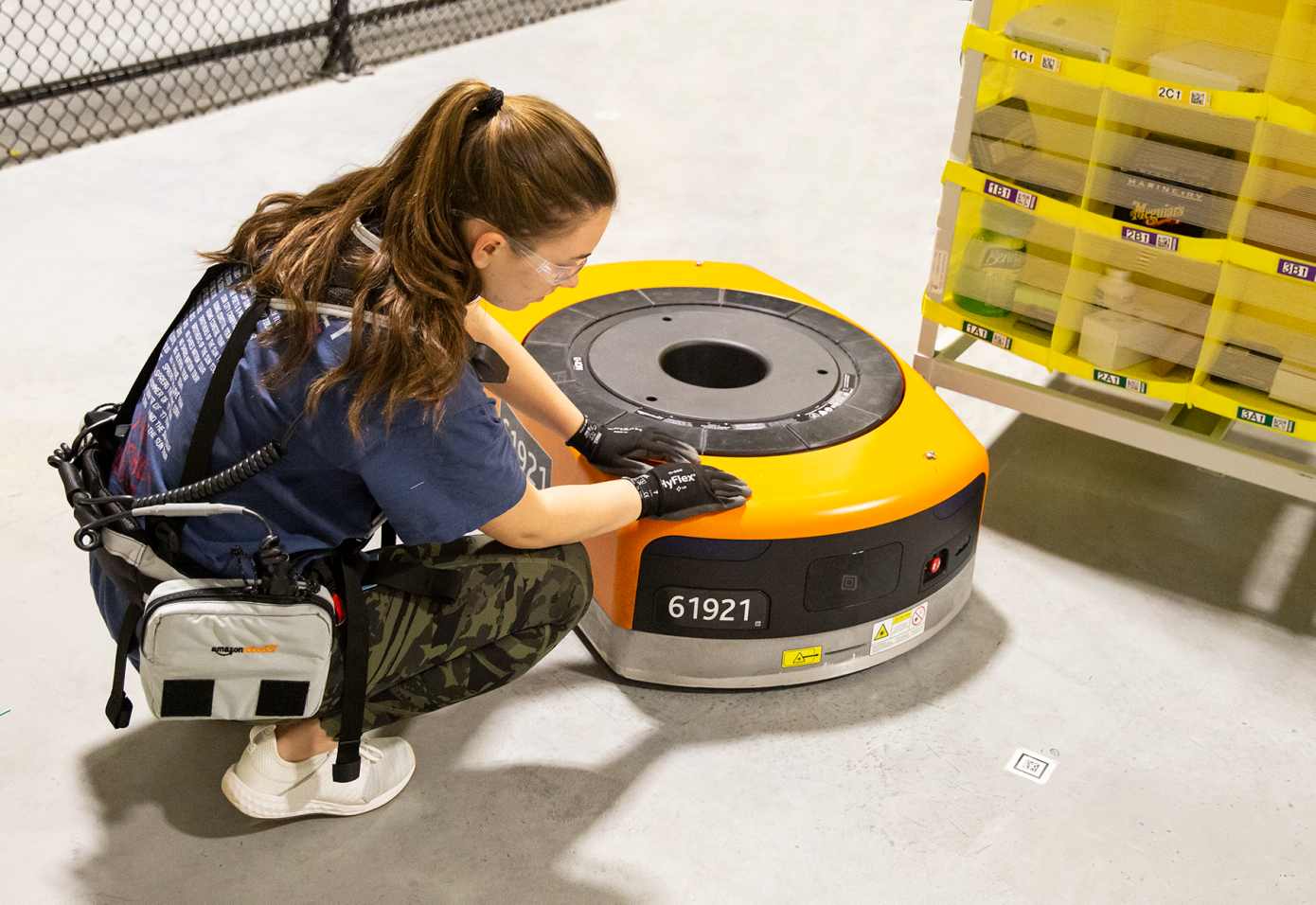 Source: Amazon RoboticsHumans working alongside robots in Amazon fulfillment centers are now outfitted with “tech vests” to prevent human/robot collisions.
Developed by Amazon Robotics — the mobile robotics fulfillment system manufacturing arm of Amazon — the tech vests contain sensors that alert container-moving robotic drive units that human workers have entered the robot’s workspace. Subsequently, the alert gives the robots enough notice to alter course and lower speed to avoid the chance for collision with humans. The vests, which according to reports resemble suspenders linked to an electronic utility belt, are meant to work in concert with the robots’ original onboard avoidance detection sensors. However, according to Amazon, the vests can detect humans at greater distances than the current onboard sensors.
Without the vests, fulfillment center employees would have to define their workspace, mapping out a grid of their work area in advance to inform the robot drive units of human whereabouts and thus areas that the robots should avoid. Yet human workers are occasionally forced to breach the perimeter surrounding areas largely dominated by automated machines to perform maintenance or to recover fallen items.
These moments, according to reports from the Occupational Safety and Health Administration (OSHA), are when the opportunity for robot/human collisions are at their greatest.
"Studies indicate that many robot accidents occur during non-routine operating conditions, such as programming, maintenance, testing, setup, or adjustment. During many of these operations the worker may temporarily be within the robot's working envelope where unintended operations could result in injuries," OSHA wrote in a study.
Since the vests were issued late last year to more than 25 Amazon fulfillment center locations, over one million vest alerts have been sent to robots in the fulfillment centers, thereby preventing opportunities for collision, according to the company.



RUN FORREST RUUUUN!!
The anti-Romulan "cloak of VISIBILITY"?
This seems like not such a good idea. I fail to see how you could implement fail-safe, dark-on activation of such a safety system.
In other words, how do you configure such a system such that if it DOESN'T see what expects it defaults to an assumption of a danger condition?
Light curtains, safety mats, and other such devices can and should be hooked up such that an electrical circuit is closed when conditions are safe, opened when hazards are present. That way, if the sensor or connection fails, it looks like a hazard situation to the system.
With Amazon's vests, what happens if a sensor fails? Everything looks "safe" and a worker gets crushed?