New materials could take flight based on bird feather structures
Engineering360 News Desk | January 18, 2019![Spacing is measured as the distance between barbules, as shown in (A). An additively manufactured bioinspired model (B) demonstrates the function of the barbule membrane flaps. This model is shown with air blown dorsally [as in the wing upstroke (C)] and ventrally [as in the downstroke (D)] at the vane. Blue circles represent the location of airflow. Micrographs of the feather vane of Anna’s hummingbird (Calypte anna) (left) and the Andean condor (Vultur gryphus) (right) demonstrate dimensional similarities on the microscale (E), while macroscale differences are shown in (F). A single barbule is highlighted in yellow in each image shown in (E). Source: University of California San Diego](/images/assets/948/10948/bird.jpg) Spacing is measured as the distance between barbules, as shown in (A). An additively manufactured bioinspired model (B) demonstrates the function of the barbule membrane flaps. This model is shown with air blown dorsally [as in the wing upstroke (C)] and ventrally [as in the downstroke (D)] at the vane. Blue circles represent the location of airflow. Micrographs of the feather vane of Anna’s hummingbird (Calypte anna) (left) and the Andean condor (Vultur gryphus) (right) demonstrate dimensional similarities on the microscale (E), while macroscale differences are shown in (F). A single barbule is highlighted in yellow in each image shown in (E). Source: University of California San Diego
Spacing is measured as the distance between barbules, as shown in (A). An additively manufactured bioinspired model (B) demonstrates the function of the barbule membrane flaps. This model is shown with air blown dorsally [as in the wing upstroke (C)] and ventrally [as in the downstroke (D)] at the vane. Blue circles represent the location of airflow. Micrographs of the feather vane of Anna’s hummingbird (Calypte anna) (left) and the Andean condor (Vultur gryphus) (right) demonstrate dimensional similarities on the microscale (E), while macroscale differences are shown in (F). A single barbule is highlighted in yellow in each image shown in (E). Source: University of California San Diego
Materials scientists are looking to bird feathers to inspire new designs for adhesives and aircraft. The general structure of feathers is under scrutiny to better understand how the underside captures air for lift and how the top blocks air to facilitate descent.
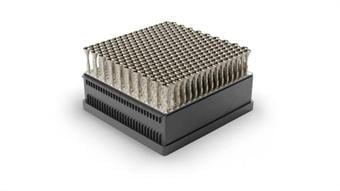
Researchers from the University of California San Diego and Saarland University, Germany, examined feathers from various bird species and 3D printed structures that replicate the vanes, barbs and barbules of feathers. The hook-like barbules that connect feather barbs were observed to be spaced within 8-16 micrometers of one another in all species, indicating the importance of this property for flight. Analysis of these structures could lead to the development of interlocking one-directional adhesives or materials with directionally tailored permeability.
Consideration of bird bone anatomy revealed that the humerus is bigger than predicted, suggesting that bone strength is limited. This is attributed to allometry, or growth of certain body parts at different rates than the body as a whole. An increase in relative humerus length is explained to be related to an increase in wing loading.
The research is published in Science Advances.