
Vessel Fire Could Have Been Prevented, NTSB Says
David Wagman | December 12, 2018An insufficient preventive maintenance program and lack of guidance for responding to engine high-temperature conditions led to a January 2018 fire aboard a small passenger vessel in the waters of the Pithlachascotee River, near Port Ritchey, Florida.
In reaching its conclusions, the National Transportation Safety Board (NTSB) said that the Island Lady was a 72 ft long passenger vessel operated by Tropical Breeze Casino Cruz to shuttle passengers and company employees to and from a casino boat.
 The Island Lady burns in January 2018. Source: NTSBTotal Loss
On the day of the fire, the Island Lady was carrying 36 passengers, a crew of four, two “pre-hires” and 11 other employees. Of the 53 people aboard that day, 15 were injured and transported to local hospitals. One passenger died several hours after the fire. Damage to the vessel, valued at $450,000, resulted in it being declared a constructive total loss.
Although the accident was not declared a major marine casualty, the NTSB investigated it as an "accident of recurring character" because of a similar fire in 2004 on another of the operating company’s vessels.
According to the NTSB report, on the day of the fire, the Island Lady was en route to the Tropical Breeze I, about nine miles offshore in the Gulf of Mexico. Just before 4 p.m., the captain received a high-temperature alarm for the port engine’s jacket-water system. The captain turned the Island Lady around to return to the dock and notified the operating company. Smoke began filling the lazarette (a storage compartment for equipment), main deck spaces and engine room. The captain beached the vessel close to shore in shallow water and all passengers, crew and company employees evacuated by jumping from the vessel into the water and wading ashore.
The NTSB said that the captain’s decision to return to the dock and beach the Island Lady was prudent and increased the likelihood of survival for those on board.
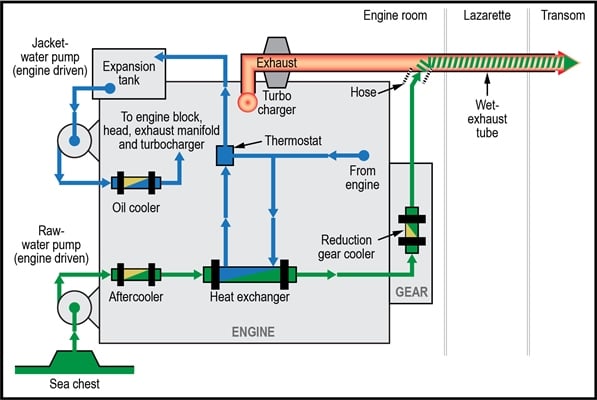 The NTSB’s investigation revealed that the failure of the port engine’s raw-water pump led to overheating of the engine and exhaust tubing, which led to the fire. Source: NTSBIncident Conclusions
The NTSB’s investigation determined, however, that Tropical Breeze Casino Cruz’s lack of guidance regarding engine high-temperature alarms led to the captain leaving the port engine idling, rather than shutting it down, leading to the fire.
The lack of a requirement for a fire detection and suppression system in an unmanned space containing engine exhaust tubing prevented early detection of, and a swifter response to, the fire in the lazarette.
And the failure of the port engine’s raw-water pump led to overheating of the engine and exhaust tubing. The raw-water pump’s failure resulted from Tropical Breeze Casino Cruz’s negligence to follow Caterpillar’s recommended maintenance schedule for the engine.
The fire's severity was enhanced due to the use of plastic tubing on local tank-level indicators and the lack of automatic shutoff valves on the fuel tanks. As a result diesel fuel was released, feeding the fire.
Recommendations
As a result of its investigation, the NTSB issued four safety recommendations with two issued to Tropical Breeze Casino Cruz LLC and two to the U.S. Coast Guard. The Coast Guard did not correctly assess the Island Lady’s fuel system’s compliance with applicable regulations during an inspection of the vessel, the NTSB said.
Safety recommendations issued to the U.S. Coast Guard seek a requirement for fire detection systems in unmanned spaces with machinery or other potential heat sources on board small passenger vessels and the issuance of a Marine Safety Information Bulletin addressing the need to use only approved material and components in fuel tank level-indicator systems.
The NTSB also reiterated two safety recommendations issued to the U.S. Coast Guard. Safety recommendation M-12-3, issued in 2012, seeks a requirement for operators of U.S.-flag passenger vessels to implement safety management systems. Safety recommendation M-02-5, issued in 2002, seeks a requirement for the development and implementation of a preventive maintenance program by companies operating domestic passenger vessels, for all systems affecting the safe operation of their vessels, including hull, mechanical and electrical systems.


I am not sure why the actual water flow is not monitored rather than the temperature.
If flow stops you have a much earlier indication of a fault than temperature, where the fault can exist for some time before alarm levels are reached.
Not only this, but you have a diagnosis of the fault at the same time - i.e. low or no flow.