Toward Graphene-Powered Renewable Fuel
Peter Brown | November 08, 2018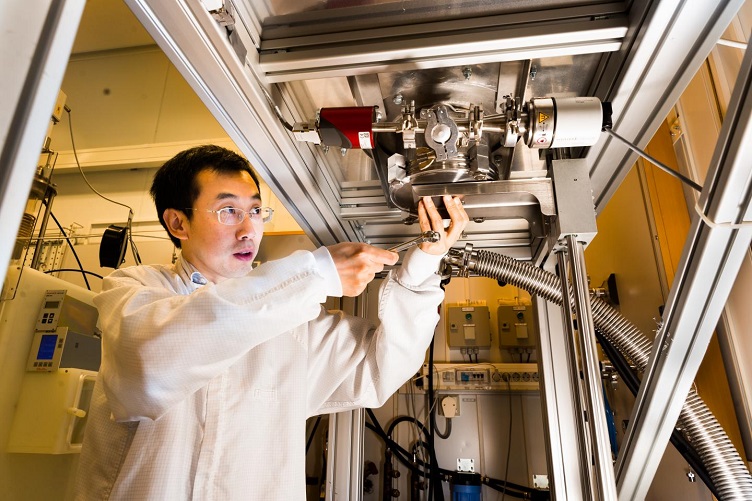 Jianwu Sun at Linköping University inspects the growth reactor of cubic silicon carbide. Source: Linköping University
Climate change is having a significant effect on the world, with the latest news indicating that the environmental impacts may be farther along than previously thought. As a result, scientists and corporations are rushing to find new ways to power anything — from the lights in our homes to the fuel for our vehicles.
Now, researchers from Linköping University of Sweden want to make the so-called "wonder material," graphene, part of the solution with a new method that uses the energy from the sun and graphene to convert water and carbon dioxide to a renewable energy.
Carbon, oxygen and hydrogen are the building blocks of chemical substances used for fuel such as ethanol and methane. The conversion of carbon dioxide and water to renewable fuel could potentially be an alternative to fossil fuels and help in reducing emissions of carbon dioxide to the atmosphere.
The research began with a previous method to produce cubic silicon carbide, which consists of silicon and carbon. The cubic form has the ability to capture energy from the sun and create charge carriers. But it isn’t enough to allow for the conversion. So researchers looked to graphene, a material comprised of a single layer of carbon atoms bound to each other in a hexagonal lattice and with a high ability to conduct an electric current, as a potential solution.
Many attempts are currently in development to improve the process by which graphene grows on a surface in order to control the properties of the material.
"It is relatively easy to grow one layer of graphene on silicon carbide,” said Jianwu Sun, researcher in the Department of Physics, Chemistry and Biology at Linköping University. “But it's a greater challenge to grow large-area uniform graphene that consists of several layers on top of each other. We have now shown that it is possible to grow uniform graphene that consists of up to four layers in a controlled manner.”
Linköping University was able to grow graphene at a carefully controlled temperature and have shown that the method makes it possible to control how many layers the graphene will contain. Sun said this is the first step in an ongoing project to make fuel from water and carbon dioxide.
"We discovered that multilayer graphene has extremely promising electrical properties that enable the material to be used as a superconductor, a material that conducts electrical current with zero electrical resistance,” Sun said. “This special property arises solely when the graphene layers are arranged in a special way relative to each other.”
The full research can be found in the journal Carbon.