Latest Seismic Imaging Techniques Overcome Obstacles Associated with Near-Surface Anomalies
Shawn Martin | November 05, 2018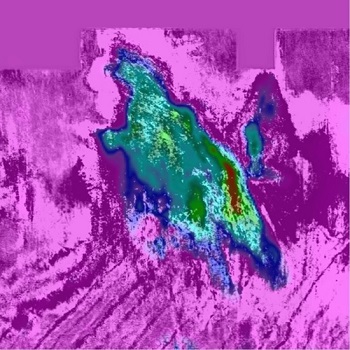 The extent of the Peon gas field. Source: CGG Multi-Client & New Ventures
Localized near-surface geological anomalies complicate seismic depth imaging, however, the latest Q modeling and Q-compensating imaging techniques help overcome challenges associated with these anomalies. They address issues with seismic wave absorption and phase distortion and provide for increased image clarity.
CGG was able to produce a model with a contiguous data volume covering 35,400 km² of the entire Northern Viking Graben in the Norwegian North Sea. The field data acquired between 2014 and 2016 was reprocessed utilizing the latest visco-acoustic (“Q”) velocity modeling and seismic imaging technologies and the results were outstanding. It clearly depicts near-surface features including the illustration of the Peon gas field to the right.
The model of the Northern Viking Graben was obtained using both Q tomography and a Q full-waveform inversion. Advanced Q-compensating migration algorithms corrected for amplitude loss and phase dispersion, which is a common problem associated with shallow gas fields.
The proven results of these high-end seismic imaging techniques may help address shallow anomalies worldwide. CGG is deploying similar techniques for another field in the Central North Sea from a 35,000 km² Cornerstone survey and has already produced high-resolution images of the Forties channels.