Watch How a Wood Sponge Separates Oil and Water
S. Himmelstein | October 25, 2018Gravity separation, bioremediation and other methods to separate oil from industrial effluents and contaminated waterways, are undermined by low efficiency, high costs and a generation of secondary pollutants. Nanocellulose-based aerogels created for this application are also not mechanically robust, consume nonrenewable 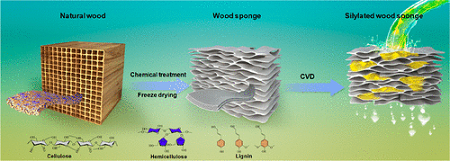 Source: American Chemical Society materials and are difficult to manufacture.
Researchers from the Chinese Academy of Forestry have engineered another treatment tool based on a renewable resource — cellulose-based wood sponges, with a special spring-like lamellar structure, made directly from natural balsa wood. The selective removal of lignin and hemicelluloses via chemical treatment broke the thin cell walls of natural wood, leaving only the cellulose skeleton. Researchers then applied a hydrophobic polysiloxane coating that attracted oil but repelled water.
The sponge demonstrated high mechanical compressibility and excellent oil/water absorption selectivity, with a high oil absorption capacity of 41 g/g. Absorbed oils can be recovered by simple mechanical squeezing, and the porous sponge maintained a high oil-absorption capacity upon multiple squeezing-absorption cycles.
The researchers observed that the low-cost sponge absorbed 16 to 41 times its own weight, depending on the type of oil, which is comparable to or better than many other reported absorbents. The sponge could also withstand at least 10 cycles of absorption and squeezing, and was incorporated into an oil-collecting device in the lab that continuously separated oils from the water surface.